Beauty is in the eye of the beholder, right?
It is true of most things to which the words “subjective” and “opinion” may be applied. And so it is with disc golf courses, as well. When I read user-submitted course reviews on dgcoursereview.com, it’s clear that different people value different features in a disc golf course.
Disc golf courses can be quite unassuming.
Some of the most popular — and most famous — are almost invisible to the uninformed eye when not populated with clusters of people flinging bright colored flying discs. That is because one of the elements of disc golf of which its practitioners and proponents are most proud is its ability to conform to nearly any hikeable environment — with minimal or no alteration. In fact, for a large part of the disc golfing population, the more rugged, the better.
And then there are those — no less ardent in their love of the sport — who highly value open, flat fairways where their discs can soar unimpeded by the “thwack!” of a tree and have no chance of plummeting into a deep, dark brambly chasm.
It’s all a personal preference.
Some players like a remote course that is so removed from the hustle and bustle of civilization (and, they might say, the watchful eyes of Big Brother) that having to hike half a mile on foot just to reach it is a bonus. For others, that would be a deal-killer. They want convenience, safety, and even supervision, and couldn’t care less if the park is shared with other users and bordered by streets with cars constantly zipping by.
For some folks it’s all about the equipment.
If a course doesn’t have some type of permanent teepads and baskets (as opposed to posts or other objects), they have zero interest in playing it. On the other end of the spectrum, I know people who still regularly play courses like Old Sawmill in Pebble Beach, Calif., or Little Africa in Carmichael, Calif., even though neither has regular targets or teepads. They do so because the courses are set in amazing places, convenient to them, and/or consist of great hole designs. But they obviously don’t mind the lack of official equipment.
So what makes a course great in your eyes?
Personally, I break it down into two broad categories: courses that I can play on a regular or semi-regular basis (home courses), and courses I may only get to play once or twice (road courses).
Home Courses
For a home course, I’m looking first and foremost for variety and challenge.
If it has those elements I’ll come back again and again, despite it possibly having some other drawbacks. I want some long holes, and some that are short and technical. It’s fun to be able to throw big, booming shots in wide open space, but if that’s all there is, it gets boring. Give me some where I have to be very accurate in navigating obstacles, as well. If the terrain is varied and allows the course to include uphill, downhill and side-hill holes, that’s also a big plus.

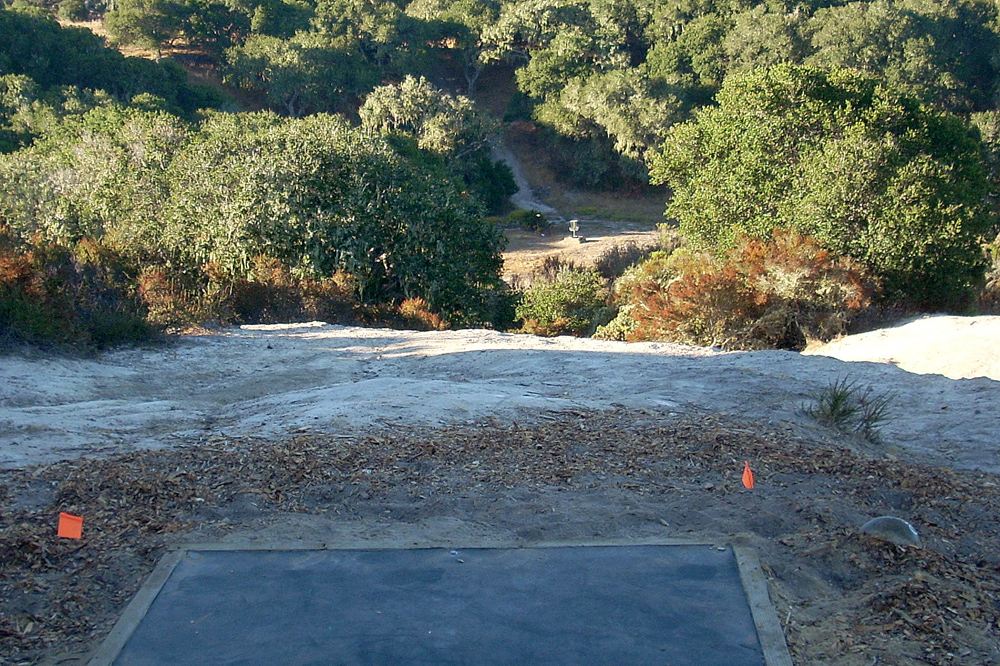
Hole No. 3 at Ryan Ranch in Monterey, Calif., is a good
example of a hole with elevation change and a well-graded,
well-marked teepad.
I want a great course design that enables me to figure out how to score better over the course of many rounds and many months or even years — like a really tough brainteasing puzzle. To me the mental aspect of golf is the best part of the game, and course management is a big part of that. It’s pretty cool to have an “a-ha!” moment on a hole after already playing it 100 times.
And a little characteristic that few courses have but one that I prize highly is the technical green.
I think it’s great when you’re forced to really think about the ramifications of a missed putt, like whether it’s gonna roll or skip away, or even fly down a drop-off behind the basket. DeLaveaga is famous for it’s tough greens, and it’s a major reason why scoring averages in major events there played by top pros remains among the highest — despite the course being more than 30 years old.
Road Courses
Now let’s use the other category to discuss some other aspects of what makes a disc golf course great or merely good (I’m pretty biased in that, to me, there is no such thing as a bad disc golf course). The factors I listed above are important to me whether home or away, but here are some others that are especially important when I don’t know the course yet.
As far as equipment goes, I’ve become spoiled by Mach III or Mach V baskets and concrete teepads, but I’m flexible — to a point. I want some form of catching device that definitely lets the player know if the hole is complete or not. And as far as teepads, I want a good, flat, hard surface from which to throw my drives. And having uniform tees and baskets isn’t just about performance.

a private course 5,000 feet up Mt. Haleakala on Maui, HI.
To him, baskets – whether manufactured or improvised –
make a big difference on a disc golf course.
So those are my major criteria. As you can see, with me it’s almost all about the game itself. Facilities (partly due to being a guy) don’t matter to me. I can pack my water in, and easily find a place in the woods to dispense with the excess. I don’t usually have much need for a place to buy snacks or discs — although I certainly appreciate it when one is available.
But now it’s your turn.
I ask again — how do you rate a disc golf course? We want to know what the most important criteria are to you (like equipment, design, amenities, price and convenience) as well as what you value within those criteria (like challenging courses or must have bathrooms).
I’m hoping to get a big response in the comments section on this one, so even if your response is short, please post something. Ideally, one day nearly every community will have numerous courses, with each catering to a different type of preference. We’re already starting to see that in disc golf hotbeds like Santa Cruz, Calif., Austin, Texas, and Charlotte, North Carolina. Players in those areas have their choice of nearly all the differences listed above. But to help the future planners and designers of courses in future disc golf hotbeds, tell us what you want to see in courses.
Jack Trageser is the founder of School of Disc Golf and the instructional writer at RattlingChains.com. You can reach him at jack@schoolofdiscgolf.com.