New disc review & giveaway: Say hello and so LONG to the Vibram Lace

Is there anything Vibram’s X-Link Rubber Compound disc’s can’t do?

For two years now I’ve touted the durability, and the grip, and even the consistent, reliable flight path. But I always assumed that distance was the one area where the tackier material made of rubber would not be able to match the sleekness and (I thought) superior aerodynamics of plastic.

After testing the Lace, Vibram’s first true long distance disc, I think I may have been wrong. Very wrong.

When I give it some thought, though, I should have seen this coming. After all, the Obex and Ibex can produce incredible distance for mid range discs, and the Trek and Ascent both fly pretty far for supposed ‘fairway drivers’. But the Lace takes things to a whole new level. I’ll do my best to explain, but after a couple fieldwork sessions and a stellar round at DeLaveaga today (-6, thanks in part to the Lace) I haven’t quite figured out how the disc flies so fast and long, so effortlessly.

This disc isn’t available in stores until November 23rd, but if you want a chance to win the tester they sent to School of Disc Golf, read on.

Those that have read my reviews in the past know I’m not big on the technical aspects of discs. I don’t flightplates diameters and all that jazz. If you need to know that stuff it’s on Vibram’s site. And while you’re there you might read their description of the disc, which says in part that it’s “like a faster Trak with a ton more glide thrown in as a bonus.” I don’t totally agree with that assessment.

While it is indeed much faster and goes way further than a Trak, this disc is way more stable. In fact, I think it’ll act like most other super-fast discs do for players without a surplus of power. I grudgingly let me friend throw it once today (hey, by the time I realized what it could do I needed it for the long holes at DeLa), and he is an accomplished player. Even after I told him it could handle all the power he wanted to give it, he still underestimated it and let it hyzer out way too soon. It’s happened to me a bunch of times too. But even when I didn’t get the gradual S-turn I plan for when going for maximum distance, I still ended up longer than expected, time and time again.

A couple times at DeLa I even discovered new possibilities- and I’ve been playing that course for almost 20 years! It’s hard to put into the right words, but when I watch the flight of my Lace I expect to find it in one place and I end up finding it somewhere else, usually further down the fairway and closer to the hole. Case in point was hole 20, a dogleg right over and around tall trees. It was my first hole of the day with the Lace and I didn’t expect it to be so stable. It hyzered way sooner than I wanted, and I started plunging into the trees thinking it went in way short and maybe even trickled down into the canyon. Nope. It was on the right fringe, but barely, and only 40 feet short of the hole. A good throw would have blasted past the basket. It’s that glide that Vibram touts.

As far as feel is concerned, the Lace has that superior grip that just makes you feel like you’re in control. Some power discs just feel in my hand that they’re uncontrollable, but not this disc. It fit into my hand comfortably and came out smoothly.

Another thing related to the rubber compound that I like: as with the other Vibram discs, it tends to stop pretty soon after touching down, which I consider a bonus with a long range driver in certain cases. There are times when you need to get 400-plus feet yet you need that disc to stop quickly afterward. Until now that really hasn’t been an option. If you wanted that distance you had to be willing to risk the possibility of skipping and/or sliding at the end of the flight. Now, with the Lace, you can have your cake and eat it too.

I don’t hide the fact that I love Vibram’s rubber discs, and I’m mildly surprised that the rest of the disc golf world hasn’t yet gone ga-ga for rubber. I guess these things take time. But I have a prediction. In golf there is the well-known saying, ‘Drive for show, putt for dough’. Distance and power gets the most attention, and now that the Lace is here, expect Vibram to start getting LOTS more attention.

Now for the contest. Since I want West Coast disc golfers to wise up to the Vibram vibe, I’m gonna do a live contest at the next DeLaveaga club monthly, December 1st at DDGC in Santa Cruz, CA. Participants will get the chance to test drive Vibram’s other drivers or mid range discs (Trek, Ascent, Ibex and Obex) and then pick one to take one crack at a CTP contest on hole 6. Winner gets the Lace. NOTE: To get in the contest, you gotta RSVP via the comments section below.

And since I don’t want to leave out readers that can’t get to the DeLa monthly, I’m also gonna give away another Vibram disc with a School of Disc Golf hotstamp to a random person who comments on this post. Let us know your thoughts on rubber vs. plastic, or something else relevant to the topic. Good luck!

Totally New Product Review: DiscBeeper

The following product review is based on the perspectives and tests of two people- myself and fellow blogger at RattlingChains.com, P.J. Harmer.

Disc golf equipment technology continues to undergo slight refinements, specifically when it comes to discs. But the advances are slight, like a disc that flies slightly faster and farther, or a basket with chains that hang at diagonal angles rather than vertically. And even in the world of disc golf accessories, nearly all products to have hit the market are manufactured versions of gadgets that do-it-yourself types likely had already been building and using on their own. Those telescoping poles that help to retrieve discs from water and trees come to mind.

The Disc Beeper falls into neither category. It’s an entirely new innovation, it solves a problem that every disc golfer encounters at one time or another (a lost disc), and despite the fact that numerous people have probably mused on a similar concept, no one has ever actually built anything like it.

The Disc Beeper is a small electronic device that has a diameter somewhere between a nickel and a quarter and weighs in at about five grams. It attaches to the bottom of a disc and when activated beeps at three second intervals after a 45-second delay, allowing the player ample time to go through her/his routine between activation and launch.

Playing primarily on mountainous and heavily wooded courses such as DeLaveaga, Pinto Lake, Black Mouse and Ryan Ranch, opportunities for lost discs abound, so I was naturally very eager to test this particular product. After putting it through a variety of trials, the early word is that it does what it is supposed to do without any noticeable detrimental effects on the flight of the disc. The bottom line is that a disc thrown with a Disc Beeper attached to it is almost certain to be reunited with its owner. This is the full review:

I received my Disc Beeper in a package that included the device, an alcohol wipe to clean the bottom of the disc I planned to attach it to, and detailed instructions on how to properly attach it. Oh yeah, and also a nifty Disc Beeper sticker. Attaching it was pretty straightforward, with the most important aspect being the centering of the Disc Beeper on the disc. Obviously if it isn’t centered, it’ll adversely affect the flight. Since the operation is pretty much irreversible, I chose a disc that was not a critical part of my ‘starting lineup’. The downside to this choice is that I won’t be able to share any specifics about how the Disc Beeper changes a disc’s flight characteristics, but that would require having two identical discs (one as the control subject of the experiment) anyway. So, no detailed feedback on how the Disc Beeper alters a disc’s flight other than to say I didn’t notice anything obvious.

The Disc Beeper is very simple to operate. It has a single button, and three different types of ‘beep’ from which to choose. I prefer the one that sounds similar to a cricket as it is just as loud and distinctive as the others while fitting best into the natural surrounds of a disc golf course. To activate you simply hit the button once turn it on, and another 1-3 times to cycle through the beep choices. After you’ve settle on a choice, you have that 45 second delay for it begins to beep at three second intervals. People who take so long to throw that they worry about the beeper going off before they’ve released the disc will realize a second benefit of this nifty product: as a training device to help them get their throws within the 30-second limit required by PDGA rules.

For my tests, I tried to come up with the best and most varied challenges possible. I wanted to see how it would perform in a noisy environment, in tall and thick vegetation, in an area where the disc could fly or roll down a steep slope, and finally a couple situations where the disc could fly so far I’d have little idea where to start searching.

The first test took place not on a disc golf course but among sand dunes next to the Pacific Ocean south of Monterey, CA. The wind was blowing hard and waves were crashing, which combined made hearing the beeper more of a challenge than at most any course I’ve played. I repeatedly threw the disc – a Champion TL – into blind spots among the dunes, then trudged in the general direction in which I had thrown. The wind also served to give me less of an idea of where the disc ended up, but inevitably I’d hear the beeping and be able to make my way to it like Yogi Bear honing in on a fresh pie.

Next I headed to Ryan Ranch, a great course also in the Monterey area. The choice was based mostly on the fact that I’m still not completely familiar with this course and as such would not automatically know where to search for a disc on each hole. It has enough elevation and rugged vegetation to lose a disc for sure. I played a regular round while there, and sometimes threw the TL for my ‘real’ shot, and other times as a second disc. As in the first test, the beeper performed exactly as it was supposed to. One thing I noticed, though is worth mentioning. I was teeing off on a blind hole and it was long enough that I needed to use my cherished ESP Nuke for my real drive. After that I threw the TL. As I walked up the fairway I heard the TL beeping from more than 100 feet away. No problem. Then I began to look for my Nuke and that familiar fear – we’ll call separation anxiety – started to creep up inside me as I couldn’t immediately locate it. I did find it after a short search, but it made me realize another benefit of the Disc Beeper: it eliminates that separation anxiety because you know you’ll hear that beeping. You know if the Disc Beeper is attached to a disc, you won’t lose it.

The nest stop on the Disc Beeper test tour was Pinto Lake, home of the finals for the 2011 Pro Worlds. The first four and last six holes are typical Santa Cruz County mountainous terrain- but they were not the setting for this round of tests. Rather it was the other nine hole, the upper holes, that would put the Disc Beeper to perhaps its toughest challenge yet. These holes are nearly all long, wide open, and flat. But the fairways are carved out of tall natural grasses and scrub brush. If your disc flies into the rough, you won’t see it until you’re almost on top of it. Add in a typically brisk wind and you can understand why the place has a reputation for swallowing Squalls and burying Buzzzes.

At this point I was pretty confident that I’d be able to find that TL no matter where it ended up, so I purposefully launched it far into the rough on one of those holes and then quickly turned around so I’d have as little idea of where it went as possible. As I walked up the fairway and listened for the beeps, I realized that I had discovered a game within the game: Follow the beeps! Needless to say, I found it that time and all the others at Pinto Lake.

The final testing ground was at famous DeLaveaga in Santa Cruz. And I had only one throw left to make. I decided to launch the disc off hole 27, ‘Top of the World’, with the intention of sending it as far as possible. Over the basket, over the street behind it, and over the parking lot on the other side of that, where a trees and a steep ravine would hopefully swallow it up. That was fun! It flew great, and long, and indeed ended up about 700 feet away, next to hole 20. But alas, the Disc Beeper removed all drama as I began to hear it from the parking lot and had no problem finding its hiding place even though I otherwise wouldn’t have had a clue where to start the search.

A few other bits on information on Disc Beeper:

  • The company expects it to sell for somewhere around the price of a premium plastic disc. They sell it on their website for $19.99, and it should be available from select retailers in the near future.
  • They also have some video clips on the site that show it in action.
  • When I told them that I thought the Disc Beeper would be more popular if it could be switched from one disc to another, rather than having to permanently attach it to one, the agreed and told me that was in the works. It’ll likely be accomplished by creating tiny neoprene sleeves that attach to the bottom of a disc. The beeper will slip snugly inside, allowing for easy transfer.
  • The power for the device is supplied by a battery that charges via a USB micro connection. This open connection could seemingly have problems with dust or moisture getting inside, but the guys at Disc Beeper have been pretty thorough with their testing so I’d guess it’s not much of an issue with normal use.
  • The PDGA is excited about the possibility of beepers on both discs and baskets enabling sight impaired people to experience disc golf. They are in the process of evaluating Disc Beeper for PDGA approval.
  • The beeps can be heard from up to 200 feet away. This could cause a problem for other players teeing off on very short holes, but in most cases the beeper wouldn’t be needed on such holes.
  • When the disc lands rightside-up on a flat surface, the beeping is noticeably quieter, but still plenty loud enough to hear it from at least 50 feet.

P.J. Harmer

There’s not, honestly, a lot I can add to Jack’s well-done review on this product.

My personal take is that this kind of a product can be a strong addition to any disc golfer’s arsenal.

The biggest thing I can note is that it needs to eventually be a product where people can switch the beeper from disc to disc. Without that ability, I find it hard to believe that disc golfers will go out and spend $100 to get five beepers for different discs.

The other reason behind that thought is if these can’t be used during sanctioned play, there needs to be a way to take them off a disc and not leave anything behind. If I am going to use the beeper, I want to have it on discs I throw. I don’t want to have a “Disc Beeper disc” and then have others. The cost-effectiveness of doing something like this would be quite bad.

I’ll be interested to watch how the PDGA goes with this as well. Though not super heavy, it does add weight to a disc and makes it a little different. If something like this is approved for play, what about things like stickers for the top of a disc and so forth? This could be a major step for what can be done to discs if this is eventually approved for competition.

In the end, this is a very cool product and I could see myself using it for casual play, especially when going to a new course. The beeper has a waterproof design and the battery charge lasts about 7-8 hours, which is easily enough for a couple of rounds. The $20 price tag isn’t much, especially if you will eventually be able to switch it from disc to disc. This kind of product will probably be suited more for the casual player (for now) as it will be nice when out throwing around.

Overall, the product was easy to use and worked as intended. The beep is loud enough so you can follow and find the disc. In the end, that’s what the product is supposed to do and it has delivered. I look forward to this product moving forward in production.

Disc Beeper on the Internet:

Product Review: Scoreband multi-use scorekeeping device

The ScoreBand is a worthy addition to any disc golfer’s bag.

(Editor’s note: Two people associated with disc golf blog Rattling Chains tested out ScoreBand, a scoring watch that also works for tennis and other things. The first part is by School of Disc Golf’s lead instructor Jack Trageser, with a review by Rattling Chain’s lead blogger P.J. Harmer following after that).

One thing in particular piqued my interest when asked to review the ScoreBand as a method for tracking disc golf scores and statistics — I wondered if it would work for someone (namely, me) that has made a persistent effort over the past several years to remain ignorant of his cumulative score during a round.

As I’ve discussed before, a primary disc golf philosophy that I espouse centers on playing disc golf in a vacuum. In a nutshell, that refers to being completly immersed with the current shot rather than letting your mind wander about things like past shots and holes, future shots and holes, other games, what’s for lunch, and especially the distraction that pertains to this review . . . total score.

Keeping that in mind, I’ve yet to come across a method for recording my score among the traditional pencil-and-card and smartphone apps. I’ve trained myself to lock each shot on each hole into my memory banks without tallying the total until the round is over.

When I heard how ScoreBand works, however, I thought it might be the first scoring method to allow me to record my score using a device more reliable than my own grey matter — without letting the insidious organ get in its own way.

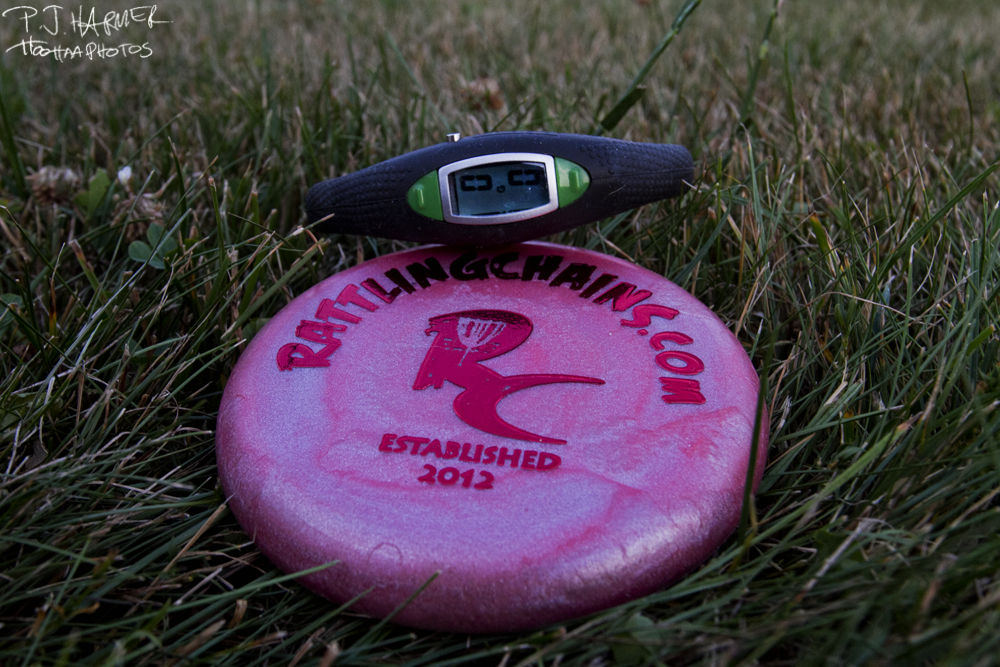
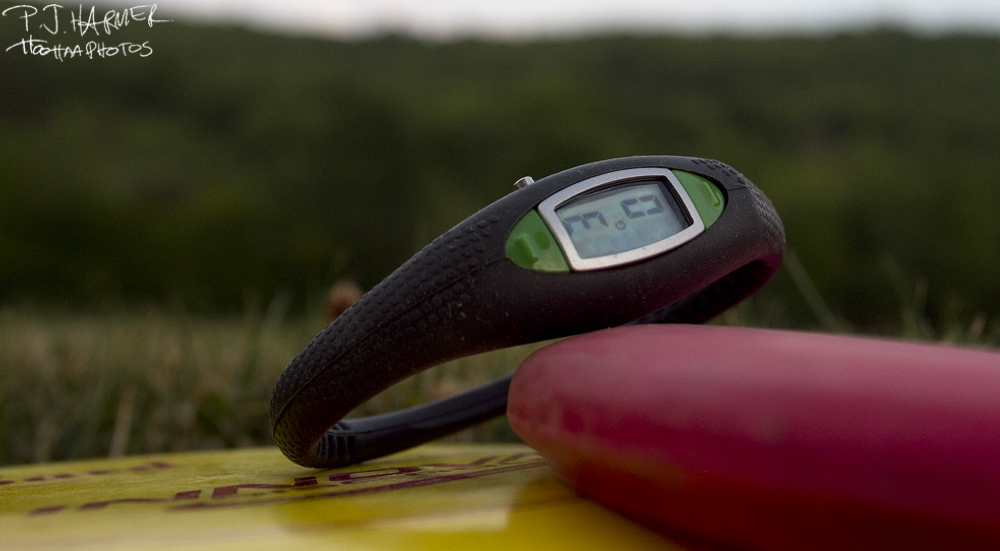
The design sets it apart from other scoring tools by being something that is worn, rather than carried, taken out and put back away repeatedly. Plus, it has a watch function, too, so you can wear it instead of your normal watch.

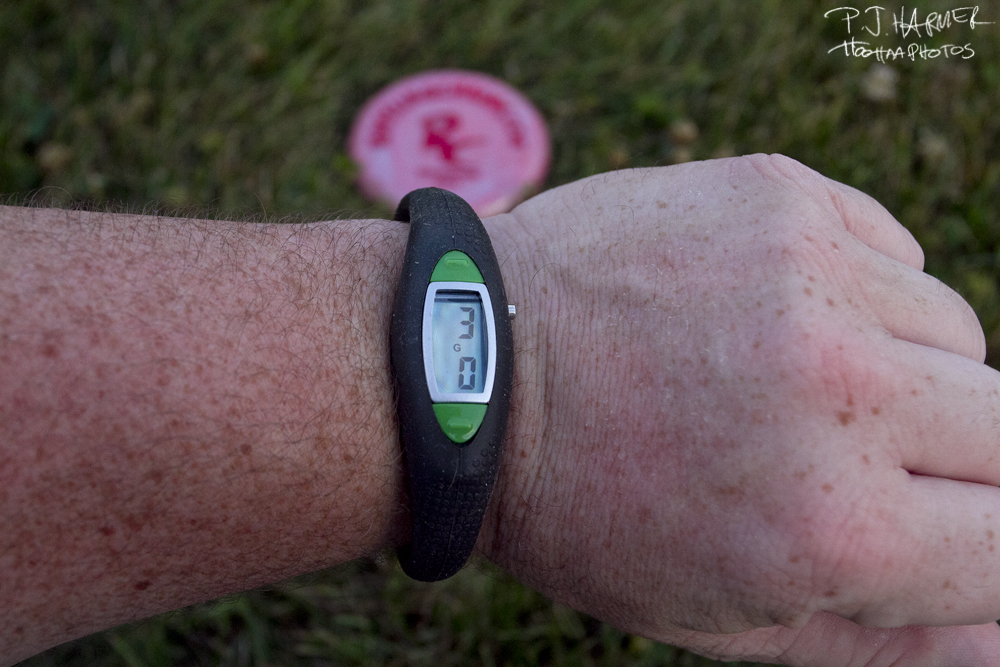
ScoreBand’s method of keeping track of the score lends itself to my personal idiosyncrasy as much as its ergonomic design. The user hits one button for each stroke to keep score on the current hole in the upper display, then presses and holds another button to add that hole’s score to the total score in the lower display.

Scoreband is a very cool concept and could help many people with disc golf scoring and many other items.

In theory, this lets a player hit the buttons the required amount of time for strokes and hold it the right duration of time to advance from one hole to another without having to even look at the screens and remain as oblivious as he or she wishes to be where total score is concerned.

In practice, however, I found using the ScoreBand to not be quite so simple (remember, these issues are magnified by my desire to not know my cumulative score during the round).

For starters, there is the issue of when to hit the button to record each stroke. Do you do it right after each throw, or wait until the completion of the hole and hit the button multiple times? In my case, during the five test rounds I played, settling on a system was not easy. In fact, it never happened. I tried to do it throw-by-throw, then would realize on the next tee that I had slacked, requiring me to enter all the strokes on that hole at one time. And it got worse, as a few times I realized I had forgotten for two entire holes.

I guess that can happen with other scoring methods as well, but having to hit a button for each stroke makes it more of an ordeal.

The upper display shows the stroke count for the current hole. When the hole is complete, you press and hold a button and the hole total is added to the round total on the lower display, while the upper one resets to zero. If you forget to record a stroke, or a hole or two, there is no way to tell which hole you last recorded successfully. It’s also an issue for those who want to know how they did hole-to-hole as at the end of the round all you have is total score.

The bottom line is that ScoreBand delivered in the main way I hoped it would. As a stretchy band worn on my non-throwing wrist, it was accessible and out of the way. Once I learned how to use it, I could hit the buttons without looking at the screens, enabling me to avoid knowing my score.

But it either takes time to get the process down to a routine, or I’m just inept at it. Of the five test rounds I played, my total came out wrong twice. I rely on my memory-based compilation after the round is over. Since I can recall each shot in my mind’s eye, it proved my use of the ScoreBand wasn’t perfect. I don’t think the device was faulty — it was a combination of my attention span and the user interface.

In January, ScoreBand was recognized as the Best Product Concept at the Professional Golf Association merchandise show. The people who awarded ScoreBand put more thought into things like that, so if you you’re like me and want a method for scoring that is handy and unobtrusive, ScoreBand may be for you.

P.J. Harmer

I’m a stat junkie.

No matter what I do, statistics fascinate me. Whether it’s softball or finds in geocaching or comparing scores on the disc golf course, I really get into it.

One thing with disc golf and me has always been keeping the score. Though there are many phone apps or pencil-and-paper ways of keeping score, I’ve been in search of a quick and easy way of keeping score as I play a round without fumbling with my phone or a pencil.

Insert ScoreBand.

ScoreBand is a rubber wristband/watch. The company calls it a “revolutionary quick-touch, 4-in-1 scorekeeping wristband engineered for sport.” It stood up to the challenge, too.

First, the construction is a one-piece rubber wristband. There are several sizes and colors to choose from, so you’ll be able to find one (or more) that fits your style. It’s comfortable to wear, though I’m not sure I could wear it all the time as I did notice it was there and with the rubber band, it could get a little tough to deal with at times.

Still, this band is easily worn for a round or two of disc golf. I wore it on the opposite wrist of my throwing hand, so I never knew it was there. Also, it made it easy for me to click the score.

I can’t comment on how this would be for ball golf as I always avoided wearing anything on my wrists when playing. I’m sure if people were used to wearing anything when swinging a club, this wouldn’t bother them. The same could be said for tennis.

The ScoreBand has four modes:

  • Golf
  • Tennis
  • All sport
  • Time

Those are four excellent items as it allows you to get multiple uses from one wristband. For golf, it keeps your hole score as well as your cumulative score. For tennis, keep game and set scores.

Though this is something that will be a permanent addition to my disc golf regiment, the all-score mode might be the most intriguing part of this band.

As the company notes on its site, there are many uses for this mode — including some other disc and ball golf functions, such as keeping putts, fairways hit or greens in regulation.

  • Other items that the watch can be used for:
  • Pitch counter for baseball or softball
  • As a head counter where attendance is needed
  • To count inventory
  • Keeping track of how many times you take medication
  • Lap counter

Truthfully, the options are endless with that mode.

Using the band is easy. There’s three buttons — two on the display and one on the side. Once you get the hang of how the watch works, it’s simple to use while playing. The key is remembering to use it.

Though I don’t often do it, perusing the instructions is a smart move and messing with it for a while before taking it out will help you get used to the controls so you can work it while on the course.

ScoreBand is a comfortable band that is easily used throughout a round.

The best part in my eyes?

It keeps your score as you go along. So if you click it after each throw or shot, you can see what you’ve done on each hole. At the end of the hole, add it to your overall score and you’ll have a clean slate for the next hole.

My only issue is it can get a little confusing on how to take your round score and add it to your cumulative score. You have to hold one of the buttons down to have it do this, but in the end, once you get used to it, it shouldn’t be an issue.

Though I love using my phone as a score card, the reality is it can sometimes get cumbersome to take the phone in and out of your pocket, get the screen up and type in scores. In the amount of time that takes, I’m at the next tee or shot with the score already in my watch.

If you are looking for more in-depth stats, the phone apps are probably the best. But if you are out playing and just want a quick and effective way to keep your score, this really is the way to go.

ScoreBand is $29.99, but it’s durable and something all disc golfers should consider having if they want a nice and easy way to keep score during rounds.