Observe, Learn and Test: The Engineer’s Approach to Disc Golf

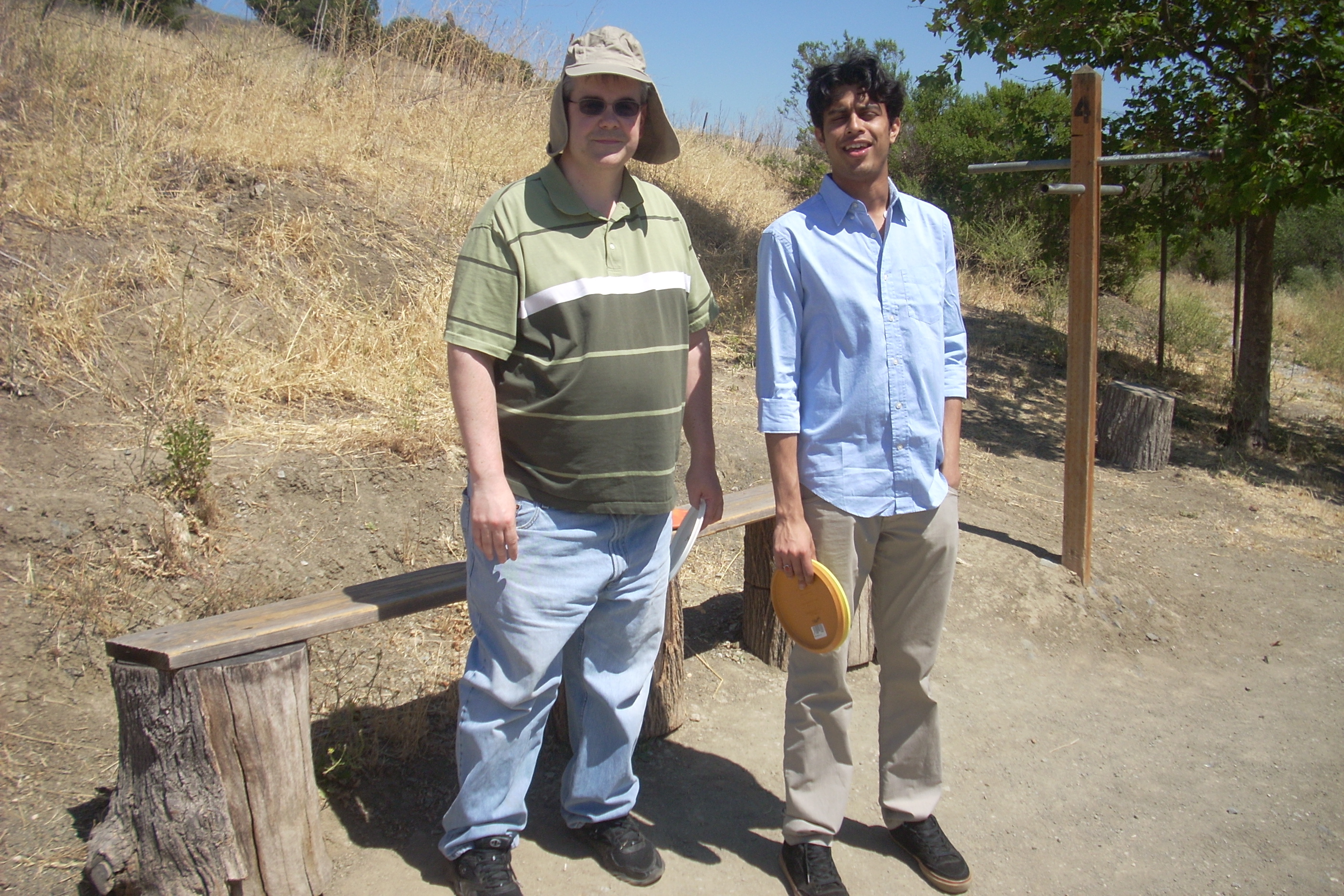
The School of Disc Golf recently hosted a team-building event for a group of engineers and other techies from a Silicon Valley company.

There were a few naturals in the group, especially one guy in particular who was launching some impressive drives and hitting long putts within 90 minutes or so of starting. I don’t think the group as a whole would mind me describing them as people whose finely honed instruments are their minds rather than their bodies.

This is not to say they were in bad shape — just not a group that, when looking at them, you’d think were jocks. They were average folks, like most golfers.

I noticed several instances of participants being able to observe their discs flying a certain way and quickly assess why. They then went about experimenting (with the help of our instruction) and making modifications to their techniques.

The really cool thing that made me want to write about that outing is the one trait this group of very regular people with very modest athletic skills had in common — an analytical, engineering-type mind. For people who are curious about how things work and enjoy solving puzzles, there aren’t many more interesting sports than disc golf.

The participants at this event improved noticeably from the beginning of the day to the end. They asked a lot of questions and, as I mentioned already, made adjustments — often dramatic — as if to test out theories for themselves on why their disc went straight up in the air, or sliced immediately left.

And give ‘em credit. Most were able to get their throws flatter and straighter by making changes, monitoring the feedback, and then making more changes based on the results.

Disc golf is known for being easy to learn, but hard to master. The aerodynamic principles of a flying disc has a lot to do with that. Leave it up to engineers to make the most of something like that. A perfectly round ball with a smooth surface will only react very subtly to efforts to manipulate its flight path, but a flying disc is totally different. It interacts with the air flow much like the sail of a ship, with even the smallest variables magnified and their effects plainly obvious.

One player really heeded the instruction he received on the differences between classic putting and throwing backhand. Once he understood the idea that a putt is more of a forward thrust than a throw, he really got the hang of it and started hitting the chains on everything. The thrill of solving the puzzle was quite obvious.
Another mild-mannered computer programmer was able to practically double his distance by employing the basic instruction of reaching back with the disc as far as possible on backhand shots before beginning the throw. He recognized some universal principles of physics — I think he mentioned catapults as being analogous — and was excited when he saw that they clearly applied to disc flight as well.

Today’s key point is to be like this group was, even if you’ve played for years. Do some research, experiment with your technique, and pay close attention to the results. Then experiment some more. Make full use of your mind as an instrument for improving your game.

Getting better, when you understand why it happens and can therefore consistently employ the improvement, is one of the most satisfying aspects of any sport. With its many possible throwing styles and the aerodynamic properties of a flying disc, disc golf makes it easier to do that than most others athletic endeavors. Take full advantage of that and you’ll get even more out of the game.

Falling putts can lower your score

Disc golfer’s familiar with the rules of the sport recognize the term ‘falling putt’ as an infraction that occurs when the disc is within 10 meters of the target. The rules (see 803.04 C) clearly state that a player – when inside this ‘putting circle,’ must demonstrate full balance after releasing the disc before advancing to retrieve his or her disc. This is to ensure players cannot gain an advantage by shortening the distance their disc has to travel. If this rule were not in place, putting would turn into a Frisbee-long jump hybrid, with players taking 10 paces backward to get a running start before leaping toward the target. I can easily imagine some nasty accidents as well, with ‘slam dunk’ attempts going horribly awry. Luckily the 10-meter rule prevents gruesome player/basket collisions while at the same time preserving the purity of the flying disc aspect of disc golf putting.

Of course, when this rule is broken it is usually much more subtle than that. The player inadvertently leans into the shot, and is unable to avoid stepping or stumbling forward. Hence the term ‘falling’ putt. But outside 10 meters no such rule applies, and using your entire body to gain added momentum can be a great strategy. If . . . . and only if, it is done correctly. Plus, even outside of the 10 meter putting circle it must be done legally.

The Disclaimer

803.04A makes it clear that the main restriction in this regard is that one point of contact (foot, knee, etc.) must be in contact with the ground at the time the disc is released, directly and no more than 30 centimeters behind the marker. So keep this restriction in mind as you read the rest of this post. Even outside 10 meters, it is illegal to break contact between your supporting point (usually a foot) and the surface behind your marker before you’ve released the disc.

The Likely Scenario

All players are different in terms of physical capabilities, of course. But generally speaking most of us can only use our putting style to a distance of somewhere between 30 and 40 feet before the need for more ‘oomph’ robs our form of its consistency and affects our aim. We put so much extra effort into getting the disc to go far enough that smoothness and fluidity is replaced by herky-jerky and disjointedness. When this happens we rarely get the disc to fly where or even how we want. So not only do we not make the putt, but we often are left with a challenging comeback putt as well.

At this point, players recognizing the need for a better approach will embrace one of two different strategies:

  1. Change from a putting, flip-style throw to a ‘regular’ throw, where the player stands sideways to the target and pulls the disc alongside his her or his body- a typical backhand throw. This method solves the need for increased power and allows the player to regain smooth form, but aim usually suffers considerably since the throwing line is no longer aligned with the sight line.
  2. Take advantage of the fact that the rules allow players to ‘fall’ forward outside 10 meters. When it’s legal, and done on purpose, this is usually referred to as a ‘jump putt’ since the result appears to be a jumping motion towards the target.

I’ll usually take the second option, but not always, depending on distance, terrain, obstacles, and situation. And like most players, I initially took the term ‘jump putt’ too literally. The term implies that you’re supposed to jump into the putt, or as you putt, but I learned there are two problems with that. First (as noted above), if your foot behind the marker leaves the ground before the disc leaves your hand, that is a rules violation. I know it’s often hard to tell, because it’s almost simultaneous, but it’s better to avoid disputes of this nature entirely if you can.

The other problem with trying to jump as you putt is that it doesn’t work! If your feet have left the ground before you release the disc, or they leave the ground right as the disc leaves your hand, you don’t really get the power you’re intending to get. Think of a shortstop in baseball trying to jump in the air and then throw the ball. It can be done, but without feet planted on the ground the arm has to supply all the power. The same is true in disc golf. Also, aim is much less consistent without the stability of those feet on the ground.

Enter the legal falling putt.

The Solution & Unique Technique

I’m not sure how I discovered this, but it enables me to putt from probably 70-80 feet with good control and consistency. By taking the straddle-putt stance (legs apart, toes pointed at the basket), then falling slowly toward the target, and putting at the last moment before my feet leave the ground, I get the best of both worlds. The momentum adds significant power in a smooth, fluid way, enabling my arm speed to stay the same as it is on a much shorter putt. And as long as I don’t get too eager and try to jump and throw at the same time, it’s remarkably accurate.

A top pro who has embraced a version of this strategy is Dave Feldberg. His approach is to ‘walk into’ long putts that require extra momentum, allowing him to use an in-line style (as opposed to switching to a straddle style) similar to his normal preferred putting style. This video clip from the 2008 Scandinavian Open (the putt occurs fast in the first second of the short clip, so you’ll have to replay it a few times) shows how he walks into the putt to gain power. His actual technique differs from mine, but the basic strategy is the same: Leverage the extra momentum of the entire body moving forward, but do so in a way that does not sacrifice the fluidity of a good, consistent putting motion.

The Bottom Line

  • Disc golfers use a separate technique for putts – where the body and eyes face directly at the target – for a good reason. What is lost in power is more than gained in the accuracy that results from having the flight line and sight line on the same line. But . . .
  • There is a definite limit to the the power that can be generated while facing the target.
  • When outside the 10-meter circle, it makes all the sense in the world to maximize power while still facing the basket (and maintaining the accuracy advantage) by legally using body momentum. But . . .
  • Techniques that cause the player to leave his/her feet too soon negate the added power by throwing off aim and timing- and might also make the throw illegal as well.
  • By using a ‘legal falling putt’ or ‘walk-into’ technique, players can gain valuable extra power without sacrificing aim or timing.

It takes some practice to get it down, but this approach will eventually result in a way to hit more long putts without as much risk of long comeback putts. Try it, you might like it!