Building blocks of basic backhand technique

Disc golf is still enough of a niche sport that by the time most of us are ensnared (like a putter caught in the inner chains of a Mach III) by an obsession to get better, we’ve already been heavily exposed to other more mainstream sports.

That reality has definite advantages for me, as an instructor, because it helps when I’m teaching a disc golf concept related to technique (or even mental stuff) to be able to draw analogies between disc golf techniques and those of other more familiar games. If someone has already learned a similar motion, it’s easier to recall that motion and apply it to disc golf than to learn it completely from scratch.

Case in point, my first remote session with a novice who was already loving disc golf but as of yet unable to throw as straight or far as his friends. We’ll call him Lou.

Without actually watching Lou throw live and in person, I had to rely mostly on the spoken and written words we exchanged on the subject in choosing my advice for him. However, I knew a couple other things that would likely prove useful.

First, players in the earlier stages of the disc golf learning curve usually make many of the same common mistakes and therefore see many of the same negative results from those mistakes. Second, Lou has talked on many occasions of being an avid softball player, so I knew right away that he would be able to easily understand the comparisons I like to use between throwing a disc golf disc using the backhand technique and proper batting technique in baseball.

Weight transfer and balance

One of the most common mistakes I see players of all levels make with the backhand shot has to do with transferring weight from the back foot to the front foot.

disc golf lessons
Figure 1: The stick in this photo illustrates the line on which players pull back the disc and throw that results in shots that pop in the air and don’t go very far.

A good backhand throw derives most of its power from the back, torso, and legs rather than just the arm. In this way (and some others, which we’ll cover soon) throwing a disc backhand is just like swinging a baseball bat with the goal of hitting the ball with any kind of power.

In both cases you’re standing at a 90-degree angle to the direction you want to throw/hit. And in both cases you want your weight to shift from your back foot to your front foot at a precise critical time. With baseball, that time is a fraction of a second before the bat hits the ball. With disc golf, it’s right as the disc is passing your body mid-throw. Any sooner in either case and you’ll rob yourself of all that power you had coiled up from your legs and torso.

Using the baseball analogy, think of what a hitter looks like when he’s way out front on a change-up or curve ball. And in the case of a backhand throw in disc golf, you’ll also likely mess up your balance and lose accuracy as well as distance.

throw straight in disc golf
Figure 2: The stick in this photo shows a proper line for a typical backhand shot intended to fly flat and straight. Note how the stick is (nearly) parallel to the ground.

Most often, the reason that disc golfers have weight transfer and balance problems is because they try to incorporate a run-up into their drives and longer fairway shots too soon. You’ve heard the saying “You have to learn to walk before you can run.” In disc golf it’s more like “before you can run-up.” Later in this post you’ll learn a great exercise for “learning to walk,” in terms of throwing a proper backhand shot.

Reach back, line, and angle

Another parallel between hitting a baseball and throwing backhand is a literal parallel. In baseball the best chance a hitter has to hit a line drive is by swinging fairly level — or parallel to the ground. The big uppercut may seem attractive to those swinging for the fences but, more often than not, results in lazy fly balls or pop-ups. In disc golf the natural tendency (usually ingrained from previous experience ‘flipping’ a Frisbee disc) is to throw on a low-to-high arc that is much like an uppercut in baseball — and the results are predictably similar.

Those throws that go way higher than you wanted (and much shorter) are the product of dropping the disc down to knee level when you pull the disc back and releasing it at eye level. There are, of course, times when you want this type of line, but not often, and rarely as exaggerated. For most throws the flatter, the better.

Continue reading “Building blocks of basic backhand technique”
Nine secrets of the women of disc golf

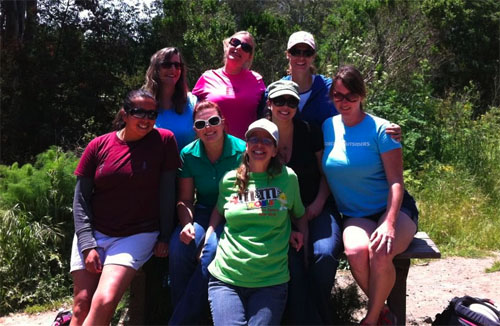
The ladies who played in the advanced division at the Masters Cup this past weekend. Pictured are: Front — Anna Caudle. Second row, from left, Victoria McCoy, Michelle Chambless, Lacey Kimbell, Cyndi Baker; and third row, from left, Christine Hernlund, Jenny Umstead, and Crissy White. (Photo by Alex Hegyi).

OK, maybe the title is a little misleading. Calling them “secrets” is overdoing it a bit, and this is about much more than that.

I spent some time last weekend talking to female competitors at the Amateur Masters Cup presented by DGA in Santa Cruz, Calif., and some of their answers might be new and useful information to the guys who play disc golf.

But are they secrets?

What’s definitely not a secret is the fact that disc golf is, and always has been, a sport played predominately by males. The breakdown of competitors in this A-Tier PDGA sanctioned event illustrates this point perfectly, as only 11 of the 158 registered participants were in female divisions. That’s less than 10 percent.

The eyeball test anytime you’re playing a recreational round on your local course will tell you that that ratio holds true in non-tournament settings as well.

So what’s the deal?

After watching the sport grow and develop over the past 25 years, I’ve got my own theories. For instance, in the early days of DeLaveaga — back in the late 1980s and early 1990s — seeing a woman on the course was rare enough to stop a guy mid-throw to ask a playing partner if he saw her, too. They had to make sure she wasn’t a mirage (or an hallucination, depending on the player). I later learned from the first female DeLa pioneers that a main deterrent was the lack of a restroom on site at the time — not even a porta-potty. Not a big deal for the average guy, but enough to keep many women away.

While not all courses are as remote and facility-less as DeLa, back then plenty of them were similarly in open spaces. And besides the lack of basic facilities, there was also an non-policed “Wild West” feel to many courses. I have a notion that many women felt these courses were just unsafe enough — or at least could be — to discourage them from giving disc golf a try.


Finally, according to golfsolutions.com (part of the Golf Channel empire), only 22 percent of ball golfers worldwide are female. So disc golf seems to be repeating the pattern of its older and more venerable ancestor.

These points add up to the fact that although disc golf may be different now than it was two decades ago, when a lopsided male/female ratio was firmly established, it self-perpetuates (the heavy guy-majority keep bringing mostly their guy friends out to play) over time.

In short, changing an established trend is hard to do, and it doesn’t happen overnight. Just look at ball golf.

Kari Rose tees off on the 10th hole at Pinto Lake, where the Daisy Chains Women’s Global Event will be held. Rose is in the pre-registered field. (Photo by John Hernlund)

As stated earlier, disc golfers have ambitious goals for growing a sport that is better in every other way possible, so the question for today is how do we get more women playing disc golf?

In searching for solutions, I sought out women who are already hooked — the female competitors of this year’s Amateur Master’s Cup.

Suzie Weigand, a local who won the Women’s Masters division by six strokes, has played disc golf for five years. She said she primarily goes out with her husband but is playing more now because of the organized “ladies days” in Santa Cruz.

Weigand said gaining momentum is important for getting more women in the game.

“When more women start playing, it’ll mushroom because it’s such an accessible activity,” she said.

As for accelerating momentum, Weigand offered the common sense strategy of “starting when they’re younger, with youth programs and high school and college leagues.”

Chrissy White, originally from Nebraska and now living in Kingsville, Calif., is a relatively new player and has put that approach into action. Her seven-year-old daughter Haley tagged along during the first round of the Masters Cup. Haley said she, too, plays disc golf.

“A lot of women that have children don’t have a sitter to watch them while they play with their husbands or boyfriends,” White said. “Bring the kids along and not only do you get to play, but the kids are going to pick it up too.”

As Victoria McCoy, of Concord, Calif., walked to the first tee, she said a key is also organizing more events that focus on women and support women. Her husband was with her for this event, carrying her bag.

This idea seems like a good one as it’s one thing to tell women they are welcome to join the sport that has, historically, only considered the needs and interests of male participants. It’s a different approach to take the sport we lover and tweak things to produce and experience that appeals particularly to women.

That’s why this Saturday’s PDGA Women’s Global Event is so special. It could mark a seminal moment in women’s disc golf.

The Daisy Chains tournament, which is one of 41 scheduled as part of the Women’s Global Event, will be run in Santa Cruz and is headed by Christine Hernlund. She reiterated the approach and stressed the intention to give the event a decidedly female feel.

“We are trying to build a tournament experience that not only avoids the common flaws of other tournaments but also has so many extras and attention to detail that the women will expect more from tournaments in the future,” Hernlund said. “The artistic and creative energy our local women have poured into this event will showcase what is possible when we women unite our strengths in a collaborative effort.”

This is all great and it’s nice to know about getting more women in disc golf, but what about those nine secrets of the women of disc golf?

Also know that these tie in directly with the main theme — increasing the numbers. You see, the last question posed to each woman was “what is the thing male disc golfers do or don’t do — on purpose or, more likely, out of ignorance — that ticks you off the most?”

Maybe if guys know what these items are, we can stop doing them and hopefully increase the odds of more women getting hooked on the game.

The nine items are:

  • They give us, especially beginners, heavy discs.
  • They get intimidated when we out-drive them, even if it’s once every 100 throws, and will often say something stupid.
  • Some of them use really foul language and can’t keep their temper in check.
  • They say “nice shot” when I know it was a really crappy shot.
  • I hate bad attitudes. Have fun with the game.
  • Stop coaching us all the time — we know what we’re doing.
  • Give credit for the good shorter shots and congratulate women when we’re doing our best.
  • Appreciate the women that come out and enjoy the sport with the men.
  • Stop looking at our butts!

That last reply was followed by much laughter as the group headed to their drives after teeing off hole one.

It would seem women do have more fun with disc golf.


This post was written for and originally appeared at rattlingchains.com.