Falling putts can lower your score

Disc golfer’s familiar with the rules of the sport recognize the term ‘falling putt’ as an infraction that occurs when the disc is within 10 meters of the target. The rules (see 803.04 C) clearly state that a player – when inside this ‘putting circle,’ must demonstrate full balance after releasing the disc before advancing to retrieve his or her disc. This is to ensure players cannot gain an advantage by shortening the distance their disc has to travel. If this rule were not in place, putting would turn into a Frisbee-long jump hybrid, with players taking 10 paces backward to get a running start before leaping toward the target. I can easily imagine some nasty accidents as well, with ‘slam dunk’ attempts going horribly awry. Luckily the 10-meter rule prevents gruesome player/basket collisions while at the same time preserving the purity of the flying disc aspect of disc golf putting.

Of course, when this rule is broken it is usually much more subtle than that. The player inadvertently leans into the shot, and is unable to avoid stepping or stumbling forward. Hence the term ‘falling’ putt. But outside 10 meters no such rule applies, and using your entire body to gain added momentum can be a great strategy. If . . . . and only if, it is done correctly. Plus, even outside of the 10 meter putting circle it must be done legally.

The Disclaimer

803.04A makes it clear that the main restriction in this regard is that one point of contact (foot, knee, etc.) must be in contact with the ground at the time the disc is released, directly and no more than 30 centimeters behind the marker. So keep this restriction in mind as you read the rest of this post. Even outside 10 meters, it is illegal to break contact between your supporting point (usually a foot) and the surface behind your marker before you’ve released the disc.

The Likely Scenario

All players are different in terms of physical capabilities, of course. But generally speaking most of us can only use our putting style to a distance of somewhere between 30 and 40 feet before the need for more ‘oomph’ robs our form of its consistency and affects our aim. We put so much extra effort into getting the disc to go far enough that smoothness and fluidity is replaced by herky-jerky and disjointedness. When this happens we rarely get the disc to fly where or even how we want. So not only do we not make the putt, but we often are left with a challenging comeback putt as well.

At this point, players recognizing the need for a better approach will embrace one of two different strategies:

  1. Change from a putting, flip-style throw to a ‘regular’ throw, where the player stands sideways to the target and pulls the disc alongside his her or his body- a typical backhand throw. This method solves the need for increased power and allows the player to regain smooth form, but aim usually suffers considerably since the throwing line is no longer aligned with the sight line.
  2. Take advantage of the fact that the rules allow players to ‘fall’ forward outside 10 meters. When it’s legal, and done on purpose, this is usually referred to as a ‘jump putt’ since the result appears to be a jumping motion towards the target.

I’ll usually take the second option, but not always, depending on distance, terrain, obstacles, and situation. And like most players, I initially took the term ‘jump putt’ too literally. The term implies that you’re supposed to jump into the putt, or as you putt, but I learned there are two problems with that. First (as noted above), if your foot behind the marker leaves the ground before the disc leaves your hand, that is a rules violation. I know it’s often hard to tell, because it’s almost simultaneous, but it’s better to avoid disputes of this nature entirely if you can.

The other problem with trying to jump as you putt is that it doesn’t work! If your feet have left the ground before you release the disc, or they leave the ground right as the disc leaves your hand, you don’t really get the power you’re intending to get. Think of a shortstop in baseball trying to jump in the air and then throw the ball. It can be done, but without feet planted on the ground the arm has to supply all the power. The same is true in disc golf. Also, aim is much less consistent without the stability of those feet on the ground.

Enter the legal falling putt.

The Solution & Unique Technique

I’m not sure how I discovered this, but it enables me to putt from probably 70-80 feet with good control and consistency. By taking the straddle-putt stance (legs apart, toes pointed at the basket), then falling slowly toward the target, and putting at the last moment before my feet leave the ground, I get the best of both worlds. The momentum adds significant power in a smooth, fluid way, enabling my arm speed to stay the same as it is on a much shorter putt. And as long as I don’t get too eager and try to jump and throw at the same time, it’s remarkably accurate.

A top pro who has embraced a version of this strategy is Dave Feldberg. His approach is to ‘walk into’ long putts that require extra momentum, allowing him to use an in-line style (as opposed to switching to a straddle style) similar to his normal preferred putting style. This video clip from the 2008 Scandinavian Open (the putt occurs fast in the first second of the short clip, so you’ll have to replay it a few times) shows how he walks into the putt to gain power. His actual technique differs from mine, but the basic strategy is the same: Leverage the extra momentum of the entire body moving forward, but do so in a way that does not sacrifice the fluidity of a good, consistent putting motion.

The Bottom Line

  • Disc golfers use a separate technique for putts – where the body and eyes face directly at the target – for a good reason. What is lost in power is more than gained in the accuracy that results from having the flight line and sight line on the same line. But . . .
  • There is a definite limit to the the power that can be generated while facing the target.
  • When outside the 10-meter circle, it makes all the sense in the world to maximize power while still facing the basket (and maintaining the accuracy advantage) by legally using body momentum. But . . .
  • Techniques that cause the player to leave his/her feet too soon negate the added power by throwing off aim and timing- and might also make the throw illegal as well.
  • By using a ‘legal falling putt’ or ‘walk-into’ technique, players can gain valuable extra power without sacrificing aim or timing.

It takes some practice to get it down, but this approach will eventually result in a way to hit more long putts without as much risk of long comeback putts. Try it, you might like it!

Building blocks of basic backhand technique

Disc golf is still enough of a niche sport that by the time most of us are ensnared (like a putter caught in the inner chains of a Mach III) by an obsession to get better, we’ve already been heavily exposed to other more mainstream sports.

That reality has definite advantages for me, as an instructor, because it helps when I’m teaching a disc golf concept related to technique (or even mental stuff) to be able to draw analogies between disc golf techniques and those of other more familiar games. If someone has already learned a similar motion, it’s easier to recall that motion and apply it to disc golf than to learn it completely from scratch.

Case in point, my first remote session with a novice who was already loving disc golf but as of yet unable to throw as straight or far as his friends. We’ll call him Lou.

Without actually watching Lou throw live and in person, I had to rely mostly on the spoken and written words we exchanged on the subject in choosing my advice for him. However, I knew a couple other things that would likely prove useful.

First, players in the earlier stages of the disc golf learning curve usually make many of the same common mistakes and therefore see many of the same negative results from those mistakes. Second, Lou has talked on many occasions of being an avid softball player, so I knew right away that he would be able to easily understand the comparisons I like to use between throwing a disc golf disc using the backhand technique and proper batting technique in baseball.

Weight transfer and balance

One of the most common mistakes I see players of all levels make with the backhand shot has to do with transferring weight from the back foot to the front foot.

disc golf lessons
Figure 1: The stick in this photo illustrates the line on which players pull back the disc and throw that results in shots that pop in the air and don’t go very far.

A good backhand throw derives most of its power from the back, torso, and legs rather than just the arm. In this way (and some others, which we’ll cover soon) throwing a disc backhand is just like swinging a baseball bat with the goal of hitting the ball with any kind of power.

In both cases you’re standing at a 90-degree angle to the direction you want to throw/hit. And in both cases you want your weight to shift from your back foot to your front foot at a precise critical time. With baseball, that time is a fraction of a second before the bat hits the ball. With disc golf, it’s right as the disc is passing your body mid-throw. Any sooner in either case and you’ll rob yourself of all that power you had coiled up from your legs and torso.

Using the baseball analogy, think of what a hitter looks like when he’s way out front on a change-up or curve ball. And in the case of a backhand throw in disc golf, you’ll also likely mess up your balance and lose accuracy as well as distance.

throw straight in disc golf
Figure 2: The stick in this photo shows a proper line for a typical backhand shot intended to fly flat and straight. Note how the stick is (nearly) parallel to the ground.

Most often, the reason that disc golfers have weight transfer and balance problems is because they try to incorporate a run-up into their drives and longer fairway shots too soon. You’ve heard the saying “You have to learn to walk before you can run.” In disc golf it’s more like “before you can run-up.” Later in this post you’ll learn a great exercise for “learning to walk,” in terms of throwing a proper backhand shot.

Reach back, line, and angle

Another parallel between hitting a baseball and throwing backhand is a literal parallel. In baseball the best chance a hitter has to hit a line drive is by swinging fairly level — or parallel to the ground. The big uppercut may seem attractive to those swinging for the fences but, more often than not, results in lazy fly balls or pop-ups. In disc golf the natural tendency (usually ingrained from previous experience ‘flipping’ a Frisbee disc) is to throw on a low-to-high arc that is much like an uppercut in baseball — and the results are predictably similar.

Those throws that go way higher than you wanted (and much shorter) are the product of dropping the disc down to knee level when you pull the disc back and releasing it at eye level. There are, of course, times when you want this type of line, but not often, and rarely as exaggerated. For most throws the flatter, the better.

Continue reading “Building blocks of basic backhand technique”

To save strokes near the basket, think like a golfer

Disc golf and ball golf can both reduce a grown man to tears, and they can both elicit language from a grown woman that would make a Marine drill sergeant blush. Is it because we, the loyal devotees of our sport, are mostly unstable people drawn to these tests of sanity like moths to a bug zapper?

BZZZT!

Well, maybe. But I have another theory.

Sure, bad breaks happen with heartbreaking and hair-pulling randomness — like my recent 40-foot putt for birdie that hit the cage 1/2 inch short of paydirt, then rolled down the sloped green and across an OB line 60 feet away (result: double bogey). Why?

No, really. WHY?!

But that kind of frustration dissipates quicker than the other kind. I’m referring to that instinctive knowledge, after a round, or a hole, or a throw, that we could have done better. Specifically, that we would have done better if not for some type of mental error. That kind can keep you tossing and turning at night.

Maybe it was a poor decision. Or the fact that it became quite obvious — a fraction of a second after the disc was released — that the wrong thought dominated the wrong lobe at the wrong time. Whatever. I’m convinced, though, that the mental side of golf is at the root of the love/hate paradox that keeps most avid players coming back again and again.

You see, even those of us with the most marginal physical skills know that if we can only squeeze all the potential out of those skills by playing smarter, our scores will improve immediately. As you read my posts here on Rattling Chains, you’ll discover this is a favorite theme of mine. We can all improve simply by playing smarter, and there are many, many, many ways to do that.

Saving strokes on the green

And what better place to start than on the green, around the basket? Mistakes related to putting are the quickest way to take needless strokes (from birdie to bogey, just like that!) so it stands to reason that plugging leaks in one’s putting game immediately translates to lower average scores.

Sticking with the leaky boat metaphor, the place to start is by identifying the biggest leaks that are the simplest to fix. In the case of disc golf putting, one of the big gushers for many players — even those that have played for years — is the line and the speed of the putt.

If I had to pick one chronic error that I think more than any other defines the separation between players who don’t consistently score well from those who do, it would have to be leaving comeback putts that are unnecessarily long. Talk about adding insult to injury! And when it’s not just bad luck, avoidable comeback putts are the result of putts that have too much speed, a line that is too flat, or (usually) both.

You have a 35-foot putt you think you can and should make, you go for it, and miss. Now you’ve got a 25-foot comeback putt, and the knowledge that you might three-putt from 35 feet tends to make it even harder to focus on that comeback putt. You feel like you’re taking such a wasted, unnecessary stroke- and you’re right. You won’t make every putt from 35 feet, but you should never do worse than two-putt from there.

The secret is to develop a line-and speed approach to putting that balances two factors — trying to make it in the basket, and making sure you leave a short, stress-free comeback putt – using a ratio that corresponds to your odds of making the putt.

The best way I can explain this concept is to use ball golf as an example, specifically a technique referred to as “lag putting.” When a ball golfer “lags” a putt, his focus is on making sure the ball ends up close to the hole for an easy next putt.

Depending on the distance from the hole and the difficulty of the perceived comeback putt a lag putt may be 50 percent “go for it” and 50 percent “make sure it ends up close,”  or it might be all about getting it close without even a thought of getting it in. But the main point is that there is some thought given to the idea that the putt might not go in on the first attempt, so golfers at least try to use the right amount of touch to ensure it ends up close enough to get it in on the next attempt.

As disc golfers we need to embrace the concept of the lag putt and make it our own. The sight of players chucking a disc right by the basket as if it were a shooting gallery rather than a golf course is way too common. Here is my explanation of a lag putting strategy, adapted for disc golf– with a bonus side benefit:

Figure 1

Line of the putt

In the simplest, most easily visualized terms, the line of any shot is the imaginary line that traces the path your disc travels from the time it leaves your hand to the time it reaches the end of its flight.

Figure 2

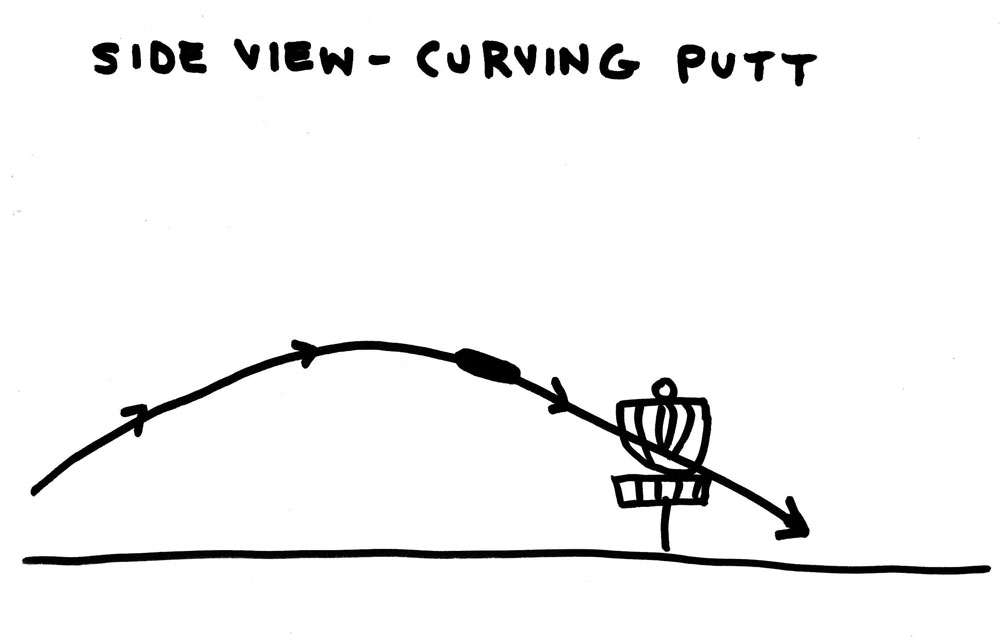
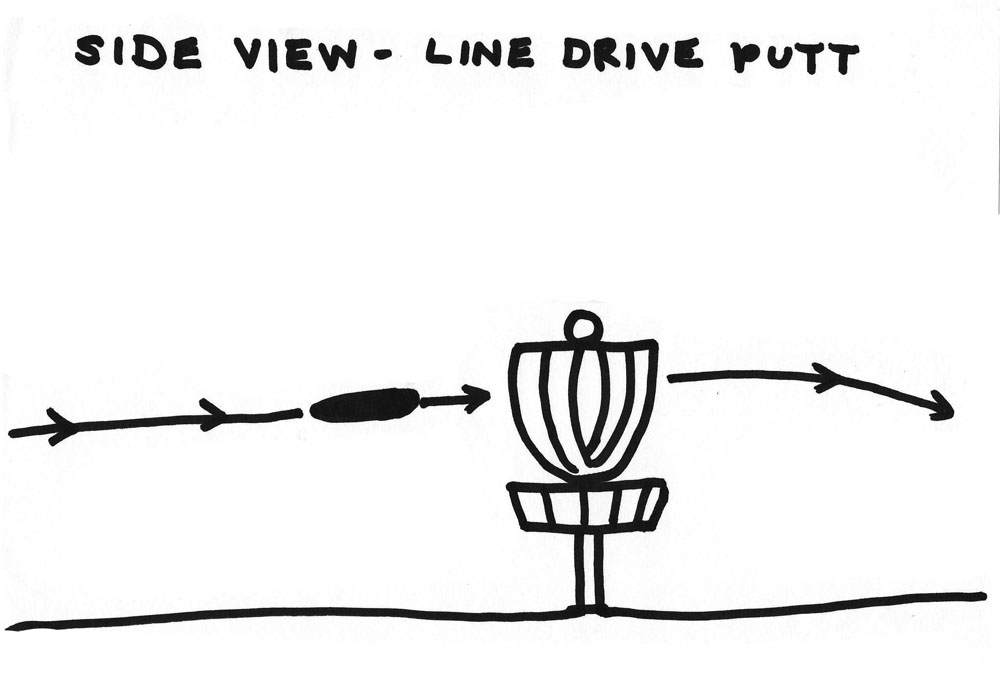
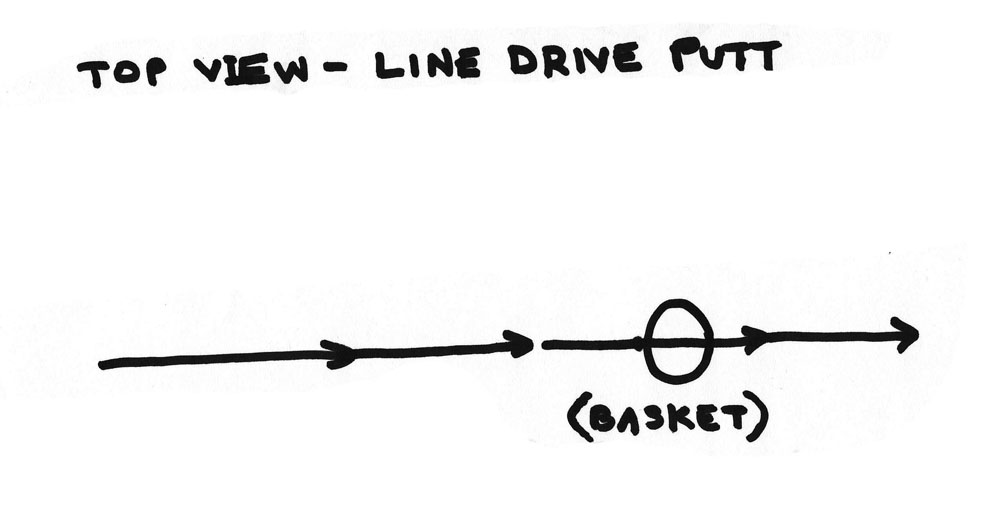
Obviously every shot in disc golf is slightly different, due to distance, obstacles, elevation change, etc. So it’s impossible to take a one-size-fits-all approach to choosing a line. But  in general the farther away from the basket you get — as your chance of making it decreases — you want your line to be more of an arc, and less of a straight line (figures 1 and 2).

The arc should be a combination of up-and-down (like shooting a basketball) and side to side. The result should be putts that are dropping and curling as they approach the basket as opposed to charging by like a train ignoring one of its stops.

Figure 3

Speed of the putt

The speed of the putt it closely tied to the line, since getting a disc to arrive at the end of a correctly chosen arc involves using just the right “touch,” which is another word for speed. But it’s worth mentioning separately because for many people it’s easier to learn this technique from a speed-and-touch approach than from an arc, or line, approach (figures 3 and 4).

Figure 4

This is especially true if you are far enough from the basket that you can’t use a true in-line or straddle putting technique, and are instead throwing your putter. Say from 70-100 feet. Far enough that you gotta throw it, but close enough that you want to at least give it some kind of run. In this case, the speed control – like lag putting in ball golf – is of utmost importance.

For putts like these the idea is to throw it just far and fast enough so the disc runs out of juice as it gets to the target. Right-handed backhand throwers want to aim high and right so the disc flies straight most of the way, then ‘falls’ down and left toward the basket on a hyzer angle.

The Bonus

Chains may be the iconic part of a disc golf basket, they can make beautiful music, and they do an amazing job at snagging discs. However, the object is for the disc to end up in the basket, and therefore longer putts with some downward momentum generally have a better chance of going in- particularly putts that are slightly off-target. So adopting an approach that combines the right arc and touch not only leaves shorter comeback putts . . . it gives your first putt a better chance to go in, too!

The Exceptions

  • On putts that are short enough that you know you should make them 99 percent of the time, I still recommend putting just hard enough to get a firm, straight line to the middle of the chains. On these putts it’s all about confidence, and tentativeness is your worst enemy.
  • On downhill putts — especially those where the green continues to slope downhill after the basket — going for it is do-or-die. If you decide to go for it on an downhill putt, using an arc or too much touch in the hope of not going too far past is a surefire way to miss completely. If you’re going for it, putt hard enough to keep it straight and flat. If you’re not sure you can make it, lay up.

This post originally appears at rattlingchains.com

Rattling Chains, an everyday disc golf blog

The School of Disc Golf is excited to announce that instructor Jack Trageser has joined the new Rattling Chains disc golf blog as a blogger focused on – what else – instructions and advice to help players improve their games.

All Rattling Chains posts will appear on this site as well, but information specific to the School of Disc Golf will usually appear only in this space.

You can read the post announcing his joining Rattling Chains here, and his first post for the site here.

Controlling emotions key to improving focus and consistency in disc golf

Golf (disc and otherwise) is a game where those who can excel in focusing on the shot at hand and consistently execute the same good mechanics get the best results. Coordination, skill, and strength are important as well, but without focus and consistency all they produce are great shots- not great rounds.

After playing disc golf for more than 15 years,  in 2005 I finally learned that an even temperament is one of the keys to achieving both. In fact, when I made controlling my emotions while playing disc golf a priority, my game hit an important turning point. I had won numerous tournaments in the Advanced division, but after moving up to Open I hit a drought of several years when I hardly ever even finished in the cash in sanctioned events. The players in the Open division  – at least the good ones – just didn’t make many mistakes. I realized that taking the next step in my evolution as a player wasn’t so much about throwing farther or getting more birdies. It was about making good decisions (called ‘game management’), and not letting one mistake turn into a snowball of superfluous strokes. That in turn led me to the realization that I needed to get better at maintaining my focus for an entire round. After all, being 8 under par after 15 holes isn’t worth much if you give back four of those hard-earned strokes in the last three holes. (And no one cares to hear about how you were tearing it up until . . . ) Here’s where controlling emotions comes in.

Proper execution requires focusing on one thing, and one thing only- planning and executing the shot at hand. You can’t do that if your mind is filled with other things, and one sure-fire way to fill your mind with other things is to get all worked up. If you yell at yourself and go through all kinds of wild gesticulations when you screw up, the thoughts associated with that outburst stick in the front of your brain like glue. It’s hard to instantly dial back into your game focus, which is required if you just hit the tree three feet in front of you and it’s your turn again. Or if you sail a putt way past the basket and ‘it’s still you.’ But golf doesn’t have a reputation as a frustrating game for no reason, and that’s often what’s required.

The other side of the coin is over exuberance. Getting super pumped up can (and more often than not does) have the same effect on one’s game. Just because the wild emotions are of the positive variety rather than negative, they still need to be controlled and kept in check. Anything that prevents you from focusing on the immediate task at hand is detrimental.

So how does a person given to strong emotions control them on the disc golf course? It’s not easy, and certainly not something that you can change right away just because you want to. Like everything else in the game, it takes practice. But if you make it a priority you will get better at it. Here are a few of the keys that helped me:

  • Every shot your throw should be a learning experience. When things don’t go your way, take a philosophical approach to it and ask yourself why. This is not to be confused with looking up at the heavens and screaming “Why?! Why?! Why?!”
  • Remind yourself that the last shot – horrible or amazing – is over. All that matters is the next shot.
  • Make self control a sort of competition within yourself. Even if you’re feeling like you want to explode, or do a Tiger Woods-ian fist-pump, don’t let it show on the outside. Pretty soon you’ll be able to restrain those emotions on the inside as well.

If you need more incentive to make better emotional control on the course the next part of your game you work on, I’ve got a couple additional benefits. First, no one likes to play with someone who throws tantrums (if you think people don’t care that you’re yelling as long as you’re yelling at yourself, think again) OR someone who loudly celebrates each of his own shots. Second, from a competitive point of view, if you play like Dr. Spock and react with the same nonchalance when you get a bad kick and roll out-of-bounds as when you can a 60-foot birdie putt, it can be unnerving to your competitors. And enjoying the sight of your adversaries getting unnerved isn’t a crime. Just don’t let it show.

Putting technique borrowed from ball golf

Watch some ball golf of TV, and pay attention to the players’ pre-shot routines on the putting green. After lining up their putts and going through any other particular aspect of his or her routine, each and every player will stand next to the ball but not close quite close enough to strike it. They then practice their putting strokes several times by swinging the club back and forth like a pendulum, coming as close to actually hitting the ball as they dare. When they’re ready to execute the actual putt, they take a small last step up to the ball, then usually go for it pretty quickly after that so as not to lose the elusive ‘touch’ required for that particular putt which the practice strokes hopefully provided.

While watching a player go through this one day and realizing the likely purpose for it (lock in the tempo and line, and establish a rhythm) I began to ponder how this exercise could be best translated to disc golf. Doing so would be huge for me personally, as most of my missed putts seem to come from a lack of ‘feel’ for the required power and tempo.

And then it hit me. Disc golfers try to emulate this practice, but because of the primary difference between our sports – ball golfers hit a ball with clubs, while we throw discs –  it is rarely done in such a way that enables us to reap the same benefits.

In disc golf, it’s common to see a player hold a putter out in front of them at eye level, ostensibly to determine the line and release point he wants. Many players will also go through a few practice ‘strokes’ as well, but most often they make two common mistakes that make the exercise pointless:

  1. Holding the disc during practice strokes means you can’t simulate one of the most important aspects- the complete follow-through. Stretching your entire arm and even fingertips toward the basket as the disc is released is crucial to good form (just look at a picture of any top pro to see what I mean), and you can’t do this while still holding on to your disc. This previous post describes a practice routine specifically designed to improve follow-through.
  2. Unless your practice strokes simulate the exact speed and motion you intend to use for your actual putt, they won’t do anything to help you establish the correct power and tempo. Once again, if you’re holding onto your disc during practice strokes this is near impossible, as well as very risky since it counts as a stroke if the disc slips out of your hand.

With all this in mind, I developed a method for disc golf putting practice strokes that borrows as much as possible from ball golf, in order to preserve the benefits of establishing the needed tempo and touch – as well as line and release point – right before the putt. Since this kind of stuff is hard to describe with words alone, I threw together a quick video tutorial demonstrating what I mean. Go ahead and watch it now, or read my description of the process first then watch it afterward. Either way, give it a try. Since putting this routine into practice, my putting is much, much more consistent. It’s been especially effective at eliminating those frustrating misses where the disc falls just short on putts inside the circle, when in the past I simply failed to use enough armspeed, and those where the line was off-target. Here’s the routine:

  1. Address your lie as you normally would, taking your normal comfortable stance.
  2. Transfer your putter to your non-throwing hand.
  3. Pick a specific link of chain in the basket to aim at, and lock your eyes on that link.
  4. While visualizing the putt you intend to make, and with an empty throwing hand, go through the exact motion required to make that putt. Pay particular attention to your armspeed, your line, the involvement of the rest of your body, and your follow-through. I exhale through my mouth at the end of each stroke just as I do on my actual putt, as this helps me exaggerate my follow-through.
  5. After whatever number of these practice strokes it takes for me to feel all elements are firmly established into a rhythm, I quickly transfer the disc to my throwing hand and execute the putt. As I transfer the disc to my throwing hand I’m only thinking two things: keep my eyes focused on my target link, and replicate the motion I established during the practice strokes.

You may be thinking that the difference of practicing your stroke without a disc in your hand and executing the actual shot would throw you off, due to the weight of the disc, but it really doesn’t. Try it, and see for yourself. As with anything else, it may take a little time to become a comfortable part of your game, but it should not take long. I noticed the benefits of establishing my line and tempo almost immediately. And after awhile I noticed an additional benefit for my mental game as well: By reducing the thoughts I want in my head right before releasing the disc to only two – focus eyes on the target link and replicate the established line sand tempo – it’s easier to keep distracting thoughts out of my head.

If you didn’t click the earlier link to watch the video tutorial that illustrates this technique, here it is. Let me know if this technique for preparing to putt works for you as well as it works for me.

Be A Sponge, Part 2: Pay Attention to Detail

DaLearning Curve, the School of Disc Golf’s instructional blog, has coined and often comes back to several themes. ‘Disc Golf in a Vaccuum’, for instance. ‘Be a sponge’ is another. This is a return to the ‘sponge’ theme.

The previous post under this heading (‘Want to Play Better: Be a Sponge‘) didn’t focus on the absorbent characteristics of a sponge, but rather the practice of ‘wringing out’ every bit of talent and knowledge one already possesses to maximize performance. In a nutshell, everyone will make errors in execution at one time or another, and that is unavoidable. It happens less to better, more consistent players, but it happens. However, mental errors are much more systemic and easier to avoid or even practically eliminate with the proper mindset. It’s worth the read if you haven’t seen it yet.

This post, however, goes back to the absorbent nature of the sponge, with three specific suggestions on how to soak up new information that can help you improve.

  1. Observe and learn from players that are much better than you
  2. Observe your own game from a detached, analytical viewpoint
  3. Listen to your body

Observe and learn from players that are much better than you

The key to this bit of advice is the fact that ‘players’ is plural. Don’t just pick one player whose game you admire and try to emulate him. He may have an unconventional style that doesn’t work for most other people (like Nate Doss’ putting technique), or maybe his physical capabilities exceed yours. Instead, observe all players whose games you admire, and try to identify traits and habits that they have in common. For instance, nearly all top players do several things exactly the same when it comes to putting, like following through in an exaggerated way. If you pay attention, you’ll also notice something about players who do well because they are consistent as well as talented: they keep their emotions in check. Players who show great abilities in stretches but rarely win in the end, on the other hand, tend to get really excited when good things happen and throw tantrums or berate themselves when bad things occur. See if you can observe these trends and others when you’re on the course, and absorb the meaning of the correlations.

Observe your own game from a detached, analytical viewpoint

There are more formal and less formal ways to do this. On the formal side, consider keeping score during all your rounds for a few months as you would in a tournament, hole by hole. Compile the scores on basic spreadsheets- one for each course you regularly play. After you’ve got 20 or so rounds compiled for a given course, do some basic math to see what your average score looks like on each hole. Examine the trends you see in the numbers, then compare the proven reality of those results with the preconceived notions with which you approach each hole. For instance, you may see that after playing a given par 3 hole 20 times, you recorded three birdies, 9 pars, 6 bogies, and two double bogies. That means that your scoring average for that hole was 3.35, well over par. If your strategy on that particular hole is to play for a birdie off the tee, you’re likely hurting your scoring chances just by making an unwise decision. You only had three birdies in the past 20 tries, after all, while during the same span collecting six bogies and two doubles! Armed with information like this, you can improve your scoring simply by remembering that that hole is a deceptive trap, changing your strategy on the tee to one that aims for a routine par rather than a not-so-realistic birdie attempt.

The best way to explain the less formal way of observing and analyzing your own game is to provide a recent personal example. On hole 23 at DeLa a couple days ago, I decided to swing my lefty drive out wide to the right side pin placement, around the large oak in the middle. As I watched the result, my initial reaction was that it went too straight and long, and would likely hit trees before being able to finish it’s hyzer skip to the right. I was happily surprised to see that the disc had indeed gotten close to the basket, ending up 20 feet below the cage. Rather than just appreciating my good fortune, hitting the putt for birdie and moving on, I asked myself why. In asking that question, I realized that recent clearing work done the hole had removed the trees and brush I would have hit in the past, and I further concluded that this change makes the outside route the clear choice for me in the future. If you’re constantly asking yourself questions on the course and trying to learn things, you’re bound to improve merely by expanding your knowledge base. Plus, it’s a good way to make even bad-scoring rounds productive.

Listen to your body

You’ve heard that phrase before, but what does it really mean? Obviously it is not to be taken literally. The creaking sound in my back doesn’t tell me much besides the fact that I am indeed getting older. Listening to your body simply means paying close attention to how it feels. No, this isn’t a ‘get in touch with your feelings’ kind of thing either. Just be really aware of what it feels like to, for instance, stretch your hand out toward the basket while following through on a putt. Think about how you can feel that stretch all the way from your shoulder through your fingertips.

Muscle memory results from repeating a motion again and again. Do something enough times and your body eventually is able to replicate the motion in a a more automatic, natural way. By active awareness of how your body feels when you putt or throw the right way, you’ll speed up the process of muscle memory.

Some disc golf tips have nothing to do with playing better

After a couple decades playing disc golf, DeLaBlagh has confirmed a few basic tenets related to the duller – as opposed to the finer – points of the game. These observations have nothing to do with playing the game, or at least not directly. But they can make your overall experience more enjoyable.

Minimizing lost discs

  • The golf disc industry thrives on the fact that people seem to really care about what color disc they throw, or what is stamped on the discs they throw. Players seem to really like multi-colored or tie-die discs in particular, and those discs tend to cost the most, too. But they are among the likeliest to be lost, because the variegated patterns are the hardest to spot when obscured in bushes and groundcover- even if the colors in the disc are bright. It’s a cruel fact that the discs with the appearance you find most attractive are often the easiest to lose.
  • Seemingly much more obvious is the fact that black discs and dark green discs tend to get lost more often as well. Seems like a no-brainer, but people still buy them, and manufacturers are happy to supply them. We’re not saying there’s a conspiracy here, just good ‘ol capitalism. And don’t think it’s OK because the discs you have that are black or green are putters. Those can get lost too, especially when it’s getting dark out.
  • Bottom line: if your goal is to lose as few discs as possible, throw solid, bright colors, and put your name and some type of contact info on them in large, bold print. If your main objective is to hold onto those discs you come to know well and trust, appearance shouldn’t be part of the equation.

Rashes, Bites and Burns
We’re based in Santa Cruz, and used to view our year-round disc golf outings as a chance to work on our tans. But the flip side to our temperate weather are the nasty perils of poison oak and wasps that build nests in the ground, practically invisible until it’s too late. We’ve long since given up wearing shorts on the courses around here. We usually wear long, thin nylon ‘shell’ pants that provide protection against the evil that lurks just off the fairways while adding little or no discomfort on hot days. Full shoes are a no-brainer.

Although we don’t really get excited about courses in grassy parks with no hazards to worry about, it’s nice to be able to dress lightly when playing disc golf once in awhile. But in all other cases, why risk it? A personal best round is quickly ruined when the indiscriminate nature of, uh, nature strikes. Remember the Father on Caddyshack?

Mind control in disc golf- first step: thinking about what you’re thinking about

How many times has any of the following happened to you?

  • You miss badly on a tricky and/or risky putt, and almost immediately after it leaves your hand you realize that although you thought you had decided to go for it, the disc comes out weak and unsure- maybe wobbling more than usual and way too low.
  • You hit a tree right after you made not hitting the tree your primary focus
  • You catch yourself thinking about your overall score, and the impact your last throw had or your next throw will have on your score, even as it’s your turn and you’re seconds away from executing that next throw

I’ve been guilty of all three. Many, many times.

And there are plenty other similar scenarios that play out over the course of any given round of disc golf, but they all have as their root cause one of two basic deficiencies – and usually a combination of both.

  1. An inability to step outside ourselves and think about what we’re thinking about. Huh?! Consider the first bullet point above. Often when that happens to me I’ll say something like this to no one in particular: “I tried to go for that, but my body didn’t agree,” or “my body didn’t let me”. And that’s really what it feels like; like my body – knowing better than my brain – refused to obey the command. In reality though, I was doubting the decision to go for it the entire time, but didn’t consciously recognize those thoughts because I wanted to go for it, ‘cuz I wanted to make it.
  2. Lack of a full appreciation of how much of an impact #1 has on a competitive round of disc golf, or lack of a plan to develop that type of mental focus.

Here’s the deal: We constantly have thoughts floating through our brains, and unless we train ourselves to monitor those thoughts most of them sneak under the radar of our self awareness. It’s like when one of your shoes comes untied as you step onto the teepad. If you don’t notice it, you’ll go right on with the scissor-step run-up to your drive and possibly trip over the errant shoelace, providing comic relief for your group and likely a disastrous result for you. Errant thoughts are just like errant shoelaces, and the trick is to learn how to be aware of them. Because once you’re aware of them, you can deal with them. Being aware of one’s shoelaces is easy- just look down at your feet before stepping on the pad (or wear Velcro shoes). Being aware of errant thoughts, though, requires a little (lot!) more effort and practice.

Just like the rest of your game, developing this awareness requires consistent practice. You will see results over time, but you must keep up the practice to keep seeing the results. So how do you practice something so vague and difficult to define? The good news (especially for those of you who hate being told the most useful practice always takes place off the course) is this is something you can practice on the course during rounds. In fact, this type of mental focus is hard to practice effectively any other way. The best way to develop this particular type of mental focus is to develop a pre-shot routine and then practice replicating it without fail whenever you play holes on the course.

Everyone that has one uses a slightly different pre-shot routine, and covering all the different types would make for another lengthy blog entry altogether. I’ll try to ask some top players about theirs in the near future and post ’em here. For now, it’s enough to know that most include a couple main components: the clear separation and repeated order of the different steps of the routine; and visualization. Both of these elements are important, because they make it easier to identify a rogue thought (see the bullets at the beginning of this entry) and replace it with the one that will give you the best chance at success.First, the steps and the order, then a few words on visualization:

  1. Assessing the situation- This step can (and should) begin as soon as the disc stops moving after your last shot. Begin considering all the factors that will help you decide what to do on your next shot (obstacles, slope, wind, odds of execution and risk/reward for your various options, etc.) and think of nothing else. A big mistake many players make is not making a conscious and focused effort to begin this step as soon as possible, then having to rush through it when it’s their turn to throw.
  2. Making a decision- Most of the heavy lifting has been done in step 1; the most important aspect of this step is to recognize the point at which you’ve made up your mind and not allow any second-guessing after that point. If you wait until it’s your turn to throw to consider all this, you’ll combine steps 1 and 2, and probably 3 as well. as you don’t want thoughts from any of these steps crossing over into the other steps. That’s when good thoughts go rogue!
  3. Execution- It’s this final part of the process where most personal idiosyncrasies can be found. It might be exactly three deep breaths before stepping up to the mini, it might be one practice stroke without the disc in hand. These are known as mechanisms that help a player tune into herself/himself and tune out distractions. But at some point in this step, visualizing the exact shot you want to throw (with a successful result) is mysteriously but amazingly effective.

Visualization
Much has been written and said about visualization, but for the purpose of this blog entry I’ll just say one thing: It helps to block out the rogue thoughts that you don’t want in your head right before you throw. It’s pretty simple, actually. If you’re thinking about something constructive, you can’t be thinking about something destructive at the same time.

If you develop a routine along these guidelines, and stay faithful to it, it’ll make it easier to identify these harmful or at best distracting thoughts so you can step back from your shot and replace them with the proper thoughts according to where you’re at in your routine. After working on it for a little while, you’ll be surprised how much better you’ll be at thinking about what your thinking about. You’ll become much more aware, more often, when your thoughts are straying away from where you want them to be. And that sense of self-awareness will help you get to the next level, no matter where your game is at now.

Ruminations on speed golf

Every now and then I substitute my thrice-weekly 3-5 mile run with a bit of speed golf. At Black Mouse DGC, a short but very mountainous track, it’s a great workout. My habit there, if time allows, is to play the course twice and aim for a time of less than an hour. Today I finished the first round in 26:26, and the the entire 36 holes in 53:05. If my math is correct, that means that the second 18 holes took 13 seconds longer than the first 18. I thought that was kinda cool, that the time it took to finish each round of 18 was so similar.

Reflecting on this bit of arcane information got me to thinking, though, about the relationship in speed golf between speed of play and score. Although it seems like a person could go faster if they were not concerned with score, once that person decides to play ‘speed golf’ for exercise I don’t believe that holds true. After all, the shortest distance between two points (say, tee to basket) is a straight line, and if you rush so much that your drive goes wildly errant and careens far off a fairway and down a hill, any time saved by rushing is canceled out by the extra hike to get to the errant disc and extra effort to hole out from there. Here is some more data from my morning round:

  • The first 18, I shot a -2, and the second 18 my score was -4
  • Although Black Mouse includes numerous blind holes and is heavily forested with redwood trees, ferns, and thick ground cover, the first round I was able to locate all my drives and upshots immediately. The second round, I had to search briefly a couple of times.
  • I didn’t feel like a lagged at all the second round due to fatigue

My guess is that if I had had as smooth a round the second 18 as the first, in terms of locating my drives, I would have finished it in less time rather than 13 seconds more. Maybe that just means that my hypothesis holds true in courses like we have here in Santa Cruz County, as opposed to flat, open, un-wooded areas.

According to Wikipedia’s entry on speed golf, speed golf competitions in ball golf use a formula where stroke play score is added to the time required to finish the round. Would the same formula be the most sensible with a disc golf version? Or would time elapsed alone be enough, with the idea that a round where the player does not shoot a good score is never going to yield a top time? I have an idea that the Running Man will have an opinion if he reads this.

Either way, it makes for a great workout and one of the best ways I know of to have fun while doing it.