Two univeral truths and 7.5 tips to help you improve your disc golf putting game

Anyone who plays golf of any kind understands putting is a big part of the game. But surprisingly, most don’t take the time to develop the systematic approach required to produce real, lasting improvement. That’s good news for those who are willing to do so- assuming you’re interested in an advantage that directly translates to lower scores and more fun (because, you know, missed putts = NOT fun).

As the title of this posts claims, we’ll examine 7.5 ways to help you in this regard, but first, a good way to start is by recognizing that there are two universal truths in regards to putting in disc golf (and ball golf, for that matter):

  1. Consistent putting is a major component to consistently scoring well in disc golf
  2. More than any other element of the game, good putting requires a solid, well-developed ‘mental’ game.

The first point is important if you play tournaments, leagues, or any other type of competition where scores are accumulated over numerous rounds. You may shoot a hot round (where you’re ‘in the zone’) every now and then, but unless you consistently make a large majority of the putts you won’t consistently score well, regardless of how great the rest of your game is. Everyone can relate to how frustrating it is to have the best drives all round yet end up not having the best score.

The second point is the theme that ties together the tips listed below. Players are all different in terms of the physical aspects of putting technique, and what works for one player (grip, stance, form, etc.) won’t necessarily work for the next. Everyone, however, faces the same challenges and can benefit from the approaches addressed below.

As this is a collection of numerous concepts and some of them have been addressed in previous posts, make sure to follow the links to get the full explanation and illustrations of those points you’re interested in implementing. The tips, in no particular order:

1. Practice like you play, and play like you practice. You may have heard this before, but allow me to explain the particular relevance of this maxim to your putting game. When you’re ‘practicing’ your putting, mindlessly throwing discs at a basket in and of itself won’t do much good. In fact, it’s likely to reinforce bad habits. You need to try to simulate a real-round scenario with every putt. Find a way to make yourself believe that something is on the line. Go through the same routine you normally would when playing, and when you’re actually putting in a round on the course you’ll be able to draw upon the confidence you built during practice.

That brings us to playing like you practice, which simply refers to telling yourself to do what you’ve proven you can do over and over again in practice. Don’t let your mind get cluttered with thoughts of how important the putt it and what’s on the line: just tell yourself it’s no different than the 12 in a row you hit from the same distance in practice- assuming you were practicing like you play.

On putts like this one at Ryan Ranch DGC in Monterey, CA, consequences must be considered when planning the shot. Photo by Jack Trageser

2. True practice strokes right before the putt. There are plenty of great lessons and techniques that can be borrowed from ball golf and applied to disc golf. This tip (the exception to list in that it is a much a technique as a mental tip) refers to the way ball golfers tend to simulate practice strokes just before the real thing in an effort to nail down the exact tempo they want to use. It’s usually not done it disc golf because of the difference between holding onto a club (which is done the same in practice swings as the one that counts) and holding onto a disc (which is obviously different, as we let the disc fly only when it’s time for the real thing). I found a way to get the best of both worlds, and it’s done wonders for my game.

To read the details on this one you’ll have to read this previous post, or for more instant gratification check out the video illustration. If you have time, though, read the post as it explains the full benefits of this pre-shot routine.

3. Develop a pre-putt routine, then stick to it. The previous tip is now a big part of my pre-shot routine. I do it every time I putt, without fail, and find it to be a big help in a number of ways. But whether you try it and use it isn’t the important thing in this tip. Everyone is different, and what works for me might not work for you. This tip is all about the importance of having some kind of routine.

You’ve probably seen the ‘above the surface’ (visible/audible) parts of others’ routines, like lining up the putt with the disc extended forward at eye level, or taking three deep breaths then stepping up to the mini-marker. These are cues that go along with the really important part of one’s routine- the progression of thoughts going through the player’s mind. Having a set routine is important because better you can stick to a set routine, the less chance fears, doubts, and random thoughts will cause you do do something you immediately regret.

Since you only have 30 seconds to execute your shot once it’s your turn to throw, that progression should start as early as possible- as soon as you’re able to size up your situation after your last throw. The first part of this mental routine involves doing all your risk-reward factoring and deciding if you’ll go for it and what type of approach you’ll take. Again, that is ideally all completed before it’s your turn to putt so that once you’re on the clock’ the actual execution is quick and decisive. The rest of your routine is covered in the next tip!

2013-03-16 11.40.07-1

3.5 When it’s time to putt, focus on the process, NOT the ‘value’ of the putt. Having a pre-shot routine is as much or more about NOT thinking the wrong thoughts as it is about thinking the right things. So many things can drift through our brains in high stress situations, and when putting almost all of them are detrimental to making the putt.

This is listed as number 3.5 on the list because it’s closely connected to number 3. Part of the reason for having a routine from which you never waver is to help you focus on the process only. If you allow emotional connects to enter your mind, like ‘I need this birdie’ or ‘if I miss this it might roll way down the hill’ or ‘I need to save par here to stay within a stroke of McBeth’ . . . let’s just say good things are less likely to happen.

Number two above is a big part of my pre-shot routine, and a perfect example of focusing on the process of executing the putt to the exclusion of everything else. During my practice strokes I visualize making a perfect putt, and go through the exact movements I would for the real putt. Then, when I’m ready for the real thing, it’s as simple as focusing on one link and telling myself the replicate the form and effort I just perfected 3-5 times in a row.

Four more tips

I promised you 7.5 tips, and so far you’ve only gotten 3.5 of them. Click here to read the other four tips now!

Gap Analysis: The science and art of navigating trees in disc golf

Many playing companions over the years have heard me mutter “I see holes” out loud at some point in my pre-shot routine during a round of disc golf. It’s a ‘go-to’ phrase of mine, and has been for probably 15 years. Some ask why I say those particular words when getting ready for certain shots, and they get the answer(s) you’re about to read below.

The funny thing about this particular mantra is that I use it for two distinctly different reasons- yet the two reasons often blend together. And the place where the two meet – the axis of risk/reward assessment (a scientific approach) and more nebulous subjects like positive thinking and confidence (closer to an art than a science) – is really the essence of the mental side of golf. As always, this is best explained through the use of specific examples, which we’ll get into, but first a brief explanation of the two reasons for “I see holes!”

The history of this mantra for me was the light bulb-over-the-head realization that even on shots where the trees and other obstacles seem so numerous that throwing a disc cleanly through and past them is impossible, it’s rarely as bleak as that. In fact, when you consider the overall area covering a particular flight path you’re hoping to take, the gaps between the trees usually represent a much larger portion of the total space than the obstructions.

After this fact became apparent to me, I would chant “I see holes” as a way to remind myself to think about and visualize a clean flight rather than dreading the relatively few disc whacking trees it had to pass. In this context it’s really just positive thinking and positive imagery, and the mantra is a way to keep my thoughts focused on the good things that I plan to happen rather than the bad things that might occur. And it really works! That’s how it started out when the phrase first popped into my head. But it was only a matter of time before my analytical side dissected the magical effectiveness of ‘I see holes’.

Ironically, as explained above my little mantra started out as a vague positive-thinking mind trick. And I’m convinced it works. But sometimes I find myself with so many trees between my lie and the basket (or whatever fairway spot I’m aiming for) that even a positive thinker along the magnitude of Stuart Smalley would have a hard time ‘seeing holes’. I’m talking about situations where I know that realistically the chances of getting through clean on the ideal line are less than 50 percent. At times like that I’m forced to choose between (to use a technical term) the least suck-y option.

When it’s time to select from different options on the golf course, the scientific side of me kicks in. Thoughts of percentages and risk/reward kick in. You would think that would preclude the nebulous realm of ‘I see holes’, but the mantra actually has a place here as well. This time, though, the more applicable adjectives are ‘practical,’ ‘sensible’, and the more golf-specific ‘high-percentage’. Depending on the situation, there are a couple different applications for this approach.

Searching Far and Wide

When your direct path to the target is blocked, look for gaps to the left and right that offer the best alternatives. Sometimes, as in Example 1 (click on the image to get a better view), you can hit the gap with a shot that will curve toward the target after it passes through. Other times the layout won’t allow for anything but a straight shot. Either way, though, it’s better to get most of the way there than aim for a tiny slot and hit something right in front of you.

Sometimes the best gap to aim for does not present a direct route to the target. But in tight spots the thing to look for is the best chance to get past the obstacle. Photo by Jack Trageser.
EXAMPLE 1: Sometimes the best gap to aim for does not present a direct route to the target. But in tight spots the thing to look for is the best chance to get past the obstacle. In this case the player needed to throw a shot that curved left after clearing that gap. Photo by Jack Trageser.

The ‘General Area’ Gap

This approach usually applies to instances where the obstacles in question are not right in front of you but further away, and evenly distributed, so that there is no single gap that is the clear choice.

In situations where I see what appears to be a wall of trees blocking my route that is far enough away that aiming for one particular small gap isn’t feasible I try to identify the least-dense section of that wall. Kind of like an attacking army would look for the weak spot that is most vulnerable. To be clear, I’m not talking about finding a single gap between two trees. In the situation I’m describing, the objective is to identify, aim for and hit a general area that offers the least resistance to a disc that wants to pass through relatively unmolested.

In a sense, I’m trying to find the one realistically hittable zone where there are more open spaces than trees (‘I see holes!’). A key point is that in situations like these I have shifted my goal away from selecting the shot that can get me all the way to the target – because there is either no realistic option for doing so or the chances that I’ll succeed are extremely low –  to selecting the shot that has the best chance to advance the disc as far as possible.

Example 2 (again, click on the image to get the necessary larger view) shows two gaps- one on the left of the photo, and one on the right. The gap on the right is the more direct route to the basket (hidden behind the trees on the right), and it is also a ‘true’ gap in the sense that a perfectly accurate throw will definitely get through. However, I chose to aim for the general area circled on the left for the following reasons: 1- even though a couple skinny tree trunks cut through the area, the overall area is much larger than the single gap on the right, and my odds of getting through are better; 2- the gap on the left provides a better worst-case scenario as there are no early trees to hit on the way to the gap (notice the early trees on the right side on the route to the gap on the right); and 3- as a left-hander throwing a backhand shot, if I get through the gap on the left with the throw I want, it will skip-hyzer right, in the direction of the basket. The right gap would require me to throw a shot that stays perfectly straight for 200-plus feet- a difficult feat to say the least.

We’ve covered a lot of ground in this article, hopefully filling a few ‘gaps’ (couldn’t resist) in your strategic and mental game. Here is a quick list of the important take-aways:

  • Most of the time, even when it seems like there are lots of obstacles in the way, it’s mostly open space (holes, you see). Focusing on the space rather than the other stuff will enable you to hit those gaps more often. In other words . . . visualize success!
  • When you find yourself hemmed into a particularly tight spot, take a wide view of all your possibly escape routes. If all the more direct paths to your target require hitting tiny openings with an unlikely perfect throw, settle for a higher-percentage throw that at least allows you to make some progress.
  • When your obstacles are further away and no single gap stands out as the obvious route to take, look for a general zone that is the most open. Then target that large zone and revert to the first bullet point: think positive!

You Make the Call

In the last photo – Example 3 – there are three routes circled. If you open the full image you can see that the basket is shown in the middle of the center gap. The question I have for you, the reader, is ‘Which gap would you choose (the right rough on hole 10 at DeLaveaga, by the way), and why’? Please use the Comments link at the end of this post to provide your answer. I’ll wait a few days for the answers to come in, then I’ll post a comment with the route that I took, and why.

In this photo the basket is to the right, behind the wall of trees. The gap on the right- despite the fact that several small tree trunks criss-cross the opening - is still the best option for the left-handed thrower. Photo by Jack Trageser.
EXAMPLE 2- In this photo the basket is to the right, behind the wall of trees. The gap on the right- despite the fact that several small tree trunks criss-cross the opening – is still the best option for the left-handed thrower. Photo by Jack Trageser.
On this one you get to make the call. Would you go for: A-the gap on the left; B- the gap in the middle; or C- the gap on the right? And most importantly, why? Vote in the comments section below. Photo by Jack Trageser.
EXAMPLE 3- On this one you get to make the call. Would you go for: A-the gap on the left; B- the gap in the middle (note, the basket is in the middle of this gap); or C- the gap on the right? And most importantly, why? Vote in the comments section below. Photo by Jack Trageser.

Casual golf’s competitive summit: the epic, friendly grudge match

I rarely dedicate an entire post to a first-person account of a disc golf round, because I know from reading others’ how quickly that can get old. But on rare occasions I feel it’ll make for good enough reading that I break my own rule- and today is just such an instance. If you aren’t familiar with DeLaveaga in Santa Cruz, CA, follow the provided links to hole descriptions to better visualize the situations described.

First a tiny bit of background. My friend Alan and I have played together since the late 90’s. Back then we used to gamble small wagers, and in the early days he was an established pro (he in fact won the Faultline Classic/California State Championship at DeLaveaga in 1994) and I was playing Am1 and just learning the craft. He hustled me more often than not, but I payed attention, and eventually my improving game and injuries on his part swung the balance in my favor. I’d say that I’ve had the advantage for the past eight years or so. But in the past few months Alan has really cranked up his game, and we’re pretty even right now. I’m sure the readers will agree that it’s much more fun if you’re evenly matched with your playing partner. Which brings us to today.

We try hard to play when the courses are not too crowded, but this weekend a Saturday 2 PM round at DeLa was the only time that would work for both of us. We’re just not used to being on the course at such a peak time. It was like a party spread over 80 acres! That, for us, is not a good thing on a golf course. Discs flying every which way, voices continually cascading up and down the ravines .  .  . it was wild, man. Crazy wild. And the wind was frenetic too. It was pretty gusty, but the really challenging aspect was the fact that it kept changing direction. You’d factor the headwind into a certain shot and just like that, tailwind.

Hole 1 was not indicative of how the rest of the round would go. Alan essentially missed the very generous double-mando and took a bogey, something he would not do much the rest of the round. After that, we both kind of dug in our heels for the next six holes with matching pars. Granted we missed opportunities on some birdie holes like 3 and 5, but considering the rowdy groups we had to play through at least we played relatively mistake-free. I had to save par after my drive on #6 crossed an OB line by one foot just right of the basket, but otherwise not much drama. Even though I’ve been landing across that OB line often lately, Alan correctly pointed out that “it makes sense to go for it when the putt to save par is less than 20 feet.”

On hole 8 things started to get interesting. We played through a group of four that was courteous enough to let us through, but out of ignorance (not malice) moved and talked during our drives. I went first, still holding the tee after hole 1, and my drive ticked something on the left side of the fairway then shot across it into the rough on the right, well short. Alan laced his Z-Glide on a nice hyzer line that would result in a birdie that got him back to par and tied the score. My compliment for how well he dealt with all the commotion in getting the good drive off could have been taken as being of the backhanded variety, due to his well-known preference for absolute silence and stillness. But he took the high road and thanked me without a hint of sarcasm. My difficult second shot saved par and prevented the dreaded two-stroke swing.

Alan picked up a second birdie in a row on the short but technical hole 8A, grabbing the lead by one. He just hasn’t been missing any make-able putts lately, and his 25-footers on both 8 and 8A were dead-center perfect. We enjoy playing subtle mind games, but I refrained making this comment out loud just yet. At this point it was still me and him against the crowds.

We both collected pars on 9, which was quite good considering the slurring slackers among the group we played through. One guy in yellow-framed pimp shades mumbled a prediction that we’d hit the trees guarding the narrow gap like his pals all did- even though he didn’t wish that fate upon us. Something along those lines, anyway. But we didn’t, and he and his friend were left in our wake (for the time being).

Hole 10 at DeLaveaga from the tee. The author's lefty drive was a technical; S turn that passed all the tree in the fairway to the left before cutting back right to the hole. Photo by John Hernlund.
Hole 10 at DeLaveaga from the tee. The author’s lefty drive was a technical; S turn that passed all the tree in the fairway to the left before cutting back right to the hole. Photo by John Hernlund.

On hole 10 I impressed the next group we passed with a high flex hyzer with a Blizzard Ape that, as planned, soared left of the trees before fading back to the right (I’m a lefty, remember) to within 28 feet. My putt found the chains for a birdie and the tie. After 11 holes we were both at -1, Alan with two birdies and one bogey, and me with that one birdie and the rest pars. Nice, clean golf.

On hole 11 with the basket in the long-left position even good drives require accurate upshots to earn par. Mine was too aggressive on the left side, and after another ricochet I ended up barely inbounds on the right with probably 50 large trees between me and the cage. I scratched out a bogey- the best I could do – and Alan turned a great second shot into a par, putting him back in the lead by one. He increased it to two with a nice drive for easy birdie on #12 in the ‘island green’ position.

After we both carded a pretty standard four on the 580-foot wooded #13, a.k.a. I-5, Alan hit a 40-foot par putt on 14 that had me wondering if he was ever going to miss a putt again. This time I couldn’t help stating as much out loud, and I sincerely meant it as a compliment rather than a sinister bit of psychological warfare.

After routine pars on 15, Alan picked up another stroke when I bogeyed 16 with a drive so horribly right that I had no option but to pitch out sideways to the fairway. “The wind!” I cried. Then his birdie on 18 (where we once again encountered the rambling, drooling fools from back on hole 9) gave him his largest lead at 4 strokes, -2 to +2.

On the next hole, 19, I received a faint glimmer of hope when we both threw near perfect drives straight up the middle. Each of us skipped into the fallen log that crosses the fairway about 20 feet in front of the short pin, but his must have rolled backward a bit because he ended up with a 35-footer. He wisely chose to lay up rather than risk the steep ravine just behind the basket, and my knee-knocker with the same backdrop went in for a birdie and the tee for the first time since hole 10. I admitted to him afterward that I’ve never been so happy to see him lay up, being certain that he’d make any putt he attempted.

On hole 20 (in the right position) I threw a tall, climbing shot with my Ape that started with a steep anhyzer angle to the left, over high tree tops, fading for the second half of the flight to the right and landing within 15 feet. Another birdie, and the lead was down to two strokes. Alan joked that it was getting warm “right around here” (pointing behind his head) and guys on the next tee overheard and yelled “He’s breathing down your neck, eh?!” Everyone had a good laugh. (It’s worth mentioning here that Alan and I haven’t always been able to jointly enjoy the moment of close competition like this. We’ve come a long way. In fact, we stopped wagering even small amounts years ago because things were just too intense. Click here to get a flavor for our competitiveness)

After pars on the next couple holes, we came to #23, a prime birdie opportunity that we both got to within 30 feet of with our drives. I went first, and nailed my tricky downhill low-ceiling putt. Alan came as close as a person can possibly come to a perfect putt himself, but missed by a fraction of an inch (Alan called it a ‘micrometer’) to the right and spit out. He also had to putt a bit firmer than normal due to the wind, or it likely would have stayed in anyway.

Down to a one-stroke lead, -2 to -1. The drama has been on a slow simmer until now, and the heat was about to get cranked up quickly for the last four holes.

Hole 25 is uphill with another slope running left-to-right, and an OB road all along the right side. The basket sits behind a wide oak tree. I stepped up and threw a perfect drive, starting it left and letting it fade right just enough to land it underneath the basket without skipping toward the road. Alan needed to match my birdie to hold his one-stroke lead, and to do that he had to start his drive over the road on the right, trusting it stay right long enough to clear the oak then hyzer back in bounds at the end. Mission accomplished. Both birdie putts were complete gimmies, making the score -3 to -2 with three to play. Before marching up the hill to the next tee, we shared a square-on high five (you know how sometimes they awkwardly miss) and a couple warm smiles. I think we both had an inkling how the round might end.

Hole 26 is also uphill – even more so – with a dramatic, steep, left-to-right slope as well. I collected a par, but Alan’s upshot just caught a lip to the right of the basket and rolled away, resulting in a bogey. Tied with two to play. He had given away so little during the round, and now an ill-timed bad break brought us even. Alan lamented how close the disc came to doing exactly what he planned, but kept his emotions in check admirably well.

Hole 26a at DeLaveaga, photo by John Hernlund

26A at DeLa is flat, on a mountaintop of sorts, with sharp drop-offs left and right. Drives need to clear a ceiling early and they must start straight to avoid early trees and finish straight to keep from dropping off either side. Alan’s drive was perfect, giving him a routine par. Mine, on the other hand, ground into the fairway early and left me an almost impossible upshot into the teeth of the wind. I thought I had pulled it off, but the wind carried it right over the basket and just over the edge of the slope on the right. Bogey. Arggh! All that work coming back from 4 strokes back, only to bogey the second to last hole! I don’t remember how well I controlled my frustration at that point, but it was definitely fighting to get out.

Stepping up to the finishing hole at DeLa at that point, on this clear, windy day, it was obvious why it’s called Top of the World. We could see everything from several holes spread out in front of us to the glimmering Pacific Ocean, and a forest of trees in between.

Alan threw first, and his drive seemed absolutely perfect out of his hand. But near the end of the flight when it should have begun fading back to the left and the basket, the wind kept it right and straight where it finally came to rest about 80 feet right and 30 or so short.

As I stepped onto the teepad, knowing his par was assured and a birdie would be necessary to tie, a couple mountain bikers approached us from being just as a couple other golfer hiked up to us from below (playing the holes out-of-order, which in disc golf is of course no big deal). Alan and I looked at eachother and both laughed because Alan had remarked earlier that people kept approaching when it was his turn to throw. Now it was my turn.

Hole 27 at DeLa, with the city of Santa Cruz and the Pacific Ocean in the background. Photo by John Hernlund.

After spouting some kind of bravado like “I feed off this” (the extra viewers) I launched my Obex hard and well left of the basket, counting on the overstable disc to hyzer back at just the right time. For those that don’t know, the long downhill hole requires throws with a downward trajectory to get all the way there, and as the disc headed for the tops of a grove of large oaks I yelled “Get up!” four or five times in rapid succession. It just cleared the trees as it began to fade right, then disappeared for a second behind those same trees. When we all saw it again, it was sweeping toward the basket, then landing 18 feet away. The guys watching were duly impressed, and after a little cheer myself I realized that if I didn’t hit the putt it meant nothing.

Due to the wind Alan chose to lay up and settle for no worse than a tie. I hit the putt, and that’s how we finished: knotted up at -2. I was glad that no one had to lose such an epic back-and-forth struggle. Alan might have felt differently, but he didn’t show it. I’ll try to get him to post something in the comments section. We’ll see if his version of any of this differs from mine.

We recorded the scores on this card after the fact, and had to use an old card from a past Masters Cup where holes 23 and 24 were not played.

Afterward we stuck around a bit and sung a few songs in the middle of the parking lot while he played his Ukelele. We’d never done that before  (at least not there) and I think we just wanted to bask a little longer in the glow of camaraderie of casual golf’s competitive summit: the epic, friendly grudge match.

The author and his playing partner relax after a tense match.
The author and his playing partner (with ukelele) relax after a tense match. Photo by Jack Trageser

The three causes for taking extra strokes in disc golf- and how to avoid ’em (if possible)

After hole 7 the other day it occurred to me that I had already carded three bogeys. To loosely paraphrase Ice Cube from back in the 90’s, I was givin’ out strokes ‘like government cheese!’

Then, in keeping with my longstanding and hopefully constructive practice of pondering why the bogies occurred rather than simply lamenting the fact, I observed each was attributable to one of the three different reasons players take extra strokes in disc golf: bad execution, mental error, and bad luck. If you haven’t thought of your disc golf game from this perspective before, it might be worthwhile to check it out. Bad luck (and good luck!) will happen when it happens and luck is impossible to control (although often times ‘bad luck’ is set up by a bad decision). Errors are another thing entirely.

Knowing which type (execution or mental) you’re more prone to commit will help you know which area of your game requires more work in order to improve performance and consistency.

To make it clearer, here are the details of those three bogies at the start of my recent round, and some related thoughts:

On hole 1 my drive was thrown too low, resulting in it turning over and grinding to a halt. Cut down in its prime. It ended up well short of my normal landing area, which on uphill hole 1 at DeLa means a difficult par save- and sure enough, I took a bogey. The problem here was purely a lack of execution. I had a good, straightforward plan, didn’t vary from my routine, and didn’t have distracting thoughts floating through my brain. Quite simply, I overthrew in an effort to compensate for the cold weather, and in the process removed all the smoothness from my form.

Hole 1 at DeLaveaga, photo by John Hernlund.

At DeLa, hole 4 requires the player to pass through trees. The course rules at DeLa also state that the two meter rule (a one-stroke penalty for discs stuck two meters or higher in a tree) is in effect. And due to the way the fairway dips down mid-way, any air shot is at least at some risk of getting snagged in some branches. Lower shots are less likely to get caught, but on that day my drive – which seemed rather perfect as it left my hand – ended up OB. The odds of that happening were quite small, but happen it did. Oh well.

Now the bogey on hole 7 was by far the most avoidable of the three. The mistake I made there was entirely mental, and those are the ones that bother me the most.

My drive had left me about 70 feet from the basket, with the slightly downhill angle of the shot making it play more like a 50-foot birdie try. But here is where I screwed up: A putt anywhere between 50 and 70 feet has a less than 50 percent chance of landing in the basket. Depending on the conditions (in this case a bit of a low ceiling near the cage) quite a bit less than 50 percent. That factor (the low probability of success) alone would not be a reason to lay up rather than go for it. But coupled with the reality that hole 7 at DeLa has a very fast, rutted fairway and a green that slopes down to the basket and far beyond, it makes birdie attempts quite risky.

Yet go for it I did, and the result was predictable. After a skip, rattle and roll, my comeback putt was around 40 feet . . . and I missed it. All I could think of was the fact that it took me three shots to hole out from 70 feet. Not acceptable.

Think about these three bogeys, and consider whether you identify with any one of the three in particular.

If you identify with Hole 1 (bad execution), you will likely see the quickest improvement through practice. Get out on a field, and get your reps in. Commit your good form and technique to muscle memory, so when it comes time for real play on the course, your body knows what to do.

If the bad break on hole 4 seems all too familiar to you, think long and hard about whether you’re really getting more than your share of bad luck or if it’s maybe the result of leaving too much to chance too often. I believe that luck evens out over time, so if you think you’re always getting the short end of the stick it’s likely because you’re not making the best decisions. At DeLa tournaments like the Masters Cup, out-of-town players often act frustrated at what they claim is the ‘fickle-factor’ connected to the course’s sloped terrain and fast greens. The players who score best in events there, however, know that these elements require special respect and adjust their games accordingly.

And that brings us to the stroke I took on hole 7. I knew the risks involved in going for that long putt with a fast, downhill green- the odds of making it didn’t match well with the odds of a miss resulting in a long comeback putt. But I went for it anyway, succumbing to whatever bad rationale happened to float through my mind at the time. Maybe it was impatience at being +2 after six holes, or maybe it was a type of bravado that led me to think nothing bad would happen if I ran the putt. But the odds played out, and what was most likely to happen did, in fact, occur.

If this type of mental error costs you the most strokes in your rounds, consider it good news. These are the easiest to eliminate as they have nothing to do with your ability to play the game. You just need to learn to get better at ‘thinking’ your way around the course. No one is perfect in this respect, but those that work at it get the most out of their abilities.

If you enjoy analyzing disc golf as much as playing it, it’s actually quite interesting to do a post-mortem on your mistakes. You’ll end up learning something nearly every time, and that means even your screw-ups can be productive in the long run.

So which of the three do you identify with the most, and more importantly, whatcha gonna do about it?

Product review: DGA Elite Shield Disc Golf Bag

After using the DGA Elite Shield bag for more than a month, it gets my endorsement as my favorite bag ever as well as in my opinion the best accessory product ever marketed by Disc Golf Association. Time will tell whether it passes the all-important durability test, but it seems to be very well equipped in that regard as well.

DGA Elite Shield disc golf bag

It should be mentioned right at the beginning that one’s preference of disc golf bags – like the golf discs they are designed to carry – is a highly subjective matter. Most significant in this regard is size. Some prefer the minimalist approach: a bag that is as small as possible and meant to hold a few discs and maybe a small water bottle. Others represent a rather different philosophy, and represent the “If there is even the remotest chance I might need it, I want to carry it” school of thought. These folks want to carry 30+ discs, two wardrobe changes, enough food and water to survive in the wilderness for 10 days, and seven miscellaneous pockets and straps full of ‘other stuff’.

I prefer something between these two extremes. I want room for around 14 discs, a large water bottle, and the outer layer of clothing I’ll remove halfway through the round. Several convenient storage pockets for my snacks and little stuff, too. And now that I’ve gotten used to backpack-style straps, my bag must at least include that as an option as well. Finally, I’d like to keep the cost reasonable- under $75.

Obviously not an overly large bag, the DGA Elite Shield nevertheless easily holds 16 discs with plenty additional storage room.

So keep in mind these personal preferences when I say that the Elite Shield bag by DGA is the ideal bag for me. Now, on with the review!

The company is best known for its dominant share of baskets installed worldwide and its pioneering status in the sport (perhaps you’ve heard of ‘Steady’ Ed Headrick, PDGA #001, Father of Disc Golf, inventor of the Pole Hole catching device), but also markets its own line of discs, apparel and accessories. They try hard to innovate in everything they do, and this bag really hits the mark in that respect and many others as well. In fact, there are so many cool features included on this bag  – a couple which are completely unique to the Elite Shield – that I’m going to list them bullet-style, along with impressions after a month’s worth of use.

  • Shield Pocket- This is the stand-out feature for which the bag is named, and it’s a hard shell storage compartment designed to keep a phone, sunglasses, or anything else you want to keep from getting broken or wet safe and sound. DGA general manager Scott Keasey told me he got the idea after watching a bag (turns out it was HIS bag) get backed over by a car. I’m not sure it would withstand the weight of a car, but I love having a place where I know my breakables will be safe. Like most great innovations, it’s simple but brilliant.
  • Gel Foam back padding- I’ve personally never had an issue with my bag feeling ‘hard’ against my back, probably because it comes into contact more with my backside than my back. Still, the padding is quite cushy and I can notice the difference.
  • Retractable Towel Lanyard- This is a detachable device that consists of a clip that attaches to a hook inside the large side pocket on one end, another clip that attaches to a towel, and a length of strong but skinny string that automatically retracts back into the device. I didn’t know at first whether I’d use this, but find that I like not having to deal with stuffing my towel back into the bag after using it. I’ve never used towel clips before because they required me to use the towel right next to the bag- which is awkward. Now, thanks to the lanyard I can have my cake, eat it too, and not worry about losing it (the towel I mean, not the cake).
  • PVC diamond-plated water resistant bottom- This is actually a biggie for me, as I play in pretty rugged terrain and the bottom of bags here is usually the most likely failure point. Most bags are not only made of the same material as the rest of the bag, but are completely flat as well. The Elite Shield’s bottom is rugged plastic, and also includes ‘feet’ that keep the bottom surface slightly elevated to reduce exposure to moisture and other wear-and-tear.
  • Foam insulated beverage pocket- My favorite parts of the beverage pocket are elastic gather at the top which keeps even my small aluminum bottle secure, even when I’m running, and the mesh plastic bottom. I hate it when my bottle leaks for whatever reason and I discover a pool of liquid accumulating in the holder. The mesh will prevent that from happening. One small downside is that a large Nalgene bottle is a tight fit. The fit is actually nice and snug and not too tight, but getting it in takes some wrangling.
Using the included customizable dividers, 14 discs fit snugly in the center of the main compartment, providing easy access to the discs in the middle and ample room for towels and clothing on either side.


The more standard features of the bag are all quite agreeable as well. It comes with a skinny should strap, but the four well-placed connectors accommodate the backpack straps of your choice. DGA sells it packaged with their Gel Strapz, but I attached mine and they work perfectly.

The storage pockets aside from the Shield pocket are all I could ask for One large zippered compartment and another small one outside of that, with a couple small ‘tuck’ sleeves outside both for a mini, pencils, or whatever (The smaller one fits my School of Disc Golf cards nicely.

The putter pocket presents one small drawback for me, but only because I will sometimes jog during and between holes on the course when time is tight. I keep two putter in the pocket, and a couple times now the one on the outside has popped out. Absolutely no concern if you’re walking on the course like most people, but speed golfers be aware that this might happen.

You can see from the images above that this is a medium-sized bag. I personally have room for 12 discs in the main compartment in addition to the two in the putter pocket, and using the included configurable dividers the discs sit neatly in a middle section, with storage in both side-corners of the main compartment for clothing, extra towels, etc. This bag can obviously hold many more than 14 discs. In fact I recently met a guy at a local course that recognized me from the TV show, and I noticed he was using an Elite Shield bag. When I told him I’d be reviewing it soon, he said he was able to fit 30 discs! Way more than DGA intended with the design, but it gives you an idea of the capacity.

DGA’s website – with the enviable URL of discgolf.com – includes a great gallery of pictures of the Elite Shield bag. It lets’s you see the bag from every conceivable angle.

If like me and Baby Bear you prefer a bag that isn’t too small, or too big, but just right, and also includes a bunch of cool extras, and is also designed to last- yet doesn’t cost too much, I think you’ll like the DGA Elite Shield bag.

Discmasters, the world’s first disc golf variety show

Most of you who read this blog know that I run School of Disc Golf as a side-gig, mainly because I thoroughly enjoy getting new players hooked on the game and helping those already addicted to get better. You’ve likely at some point read that I used to play all the tournaments I could get to, topped out at a 999 player rating (so close!) and for a time was an officer of the DeLaveaga Disc Golf Club.

What I don’t think I’ve mentioned in quite a while in this space – if ever – is another off-and-on project of mine- Discmasters TV. Since the first new episode in quite a while just hit YouTube I thought I’d take a little time to tell you about the show and its origins.

It all started when I came across a video on YouTube that covered a tournament in Santa Cruz called the Faultline Classic. I thought the video was well-produced given the obviously limited technical resources and decided to approach the guy who posted it with an idea I had been tossing around for some time. The concept was for a ‘lighter side of disc golf’ type variety show that would incorporate instruction, interviews, and cheesy, badly-acted comedy. It should come as no surprise the last part came naturally.

My original model for the show and indeed the name itself came from a cheaply-produced fishing show from the 80’s called Fishmasters that itself was a spoof on another show called Bassmasters. I liked the way Fishmasters turned their minimal technical capabilities (which I think were still greater than ours) into a positive by having it add to the comedic element of the show- knowing that anything we could muster would have the same limitations.

So as I said, I contacted the guy who posted that original Faultline Classic video and learned that he worked for Community TV in Santa Cruz, and the video had actually been broadcast there first, on local TV. At this point, let me introduce that guy- Ben Baker.

Ben had a year or two before that graduated from San Francisco State University with a film degree, and his job at the TV station was his first film-related position. He liked the idea as much as I did, and was even more excited when I told him that I had spoken to disc golf luminaries (and friends) Nate Doss, Valarie Jenkins and Avery Jenkins and gotten them to agree to participate as well. As luck would have it, the disc golf touring season had just ended and Nate, Val and Avery would be in Santa Cruz for the next couple months, enabling us to spend time in both the studio and on courses shooting footage.

A side-note about Ben: When we started the project he was enthusiastic about disc golf but pretty much a novice player. His sidearm shot had power yet score-wise he was all over the place. I even hustled a lunch out of him giving him a stroke per-hole at DeLa (that’s 28 strokes!). Ben was not altogether pleased with that introduction to disc golf gambling. That was a couple years ago. This past season, he captured the overall Championship for the venerable NorCal Series tour in the AM2 division. Good for you, Ben! I’d like to think that my instruction and Val, Avery and Nate’s excellence rubbed off on him.

As we envisioned, the show has covered lots of disc golf-related territory. There have been instructional posts by me (on the show known as Jack Tupp), Nate, Avery, Val and even one on putting by Nikko Locastro. There has been lots of tournament coverage, including the 2011 Pro World Championships and the Otter Open in Monterey.

Lots of disc golf celebrity appearances in addition to our regulars: Greg Barsby, Eric McCabe, and Nikko come to mind, but there have been plenty of others (you’ll have to watch the shows to find out who else.) Viewers also get introduced to players known better in Santa Cruz than the rest of the dg world, like Shasta Criss, Don Smith, Tony Tran, and Jon Baldwin (who became World Champion in the Masters division after his Discmasters appearance).

We  managed to get a cool logo created by Nate’s step-sister, the talented Audrey Karleskind. Even a cool theme song (lyrics by Yours Truly). And of course, there have been numerous bits of cheesy comedy.

My favorites are the ones that involve me playing bongo drums while Avery tries to putt, followed by Avery nailing me with a disc with Kung-Fu like accuracy, and magic minis that adversely affect my wardrobe. And of course there is the hipster-doofus named Jimmy Shank. Gotta love that guy. And possibly the best is yet to come as we shot some great footage in which Valarie stars. Stay tuned for that.

The just-released clip I mentioned earlier is a 48-minute studio interview of disc golf hall-of-famer Tom Schot and Monterey disc golf pioneer Merle Witvoet. It was shot just before the 2011 Pro Worlds so part of the talk is about that, but I think the most interesting discussion centers on the history of disc golf in Santa Cruz, of which Schot is principally responsible. Disc golf historians should find it interesting.

The best way to see all the episodes and other miscellaneous short clips is to visit the DiscmastersTV channel on YouTube. And if you’re eager to see new episodes, visit the Discmasters page on Facebook and let us know. Hope you enjoy watching them as much as we do shooting them.

Roller Shots, Part 2: Now we tell you How

The first thing to know about throwing roller shots is that if you can throw backhand and sidearm, you already know much of what you need to know. Roller shots don’t require learning an entirely new technique- just a new twist on your most basic throws. Whereas with most air shots the aim is to keep the disc aloft most of the way to the target, roller shots need to hit the ground early. And as opposed to air shots, where you usually want the disc to land mostly flat it won’t roll away, roller shots are calculated to not only land on it’s edge but on its edge at a specific angle so it goes the direction and distance you intend.

By the way, if you didn’t catch Part 1 of this instructional post – which covers the Who, What, When, Where and Why of roller shots, you can check it out here (ADD LINKS).

Now on to the How.

Proper roller technique requires a high release point, exaggerated nose angle, and a torso with a tilted axis.

Much of what I know about throwing roller shots comes from my personal roller mentor, Alan ‘Flash’ Friedman. I tapped into his knowledge base for this post, and even filmed a quick video and posted it on YouTube. Don’t be lazy and just watch the video, though, as all by itself it doesn’t do a great job of explaining how to properly throw rollers.

According to Flash, there are two types of roller shots- the finesse version (thrown using understable or ‘beat’ discs), and ‘high-tech’ rollers that require an overstable disc.

The finesse roller has been around for as long as people have been throwing flying discs, and was discovered initially due to the relative understable nature of early discs. As we all know, if a disc can’t handle the amount of speed and spin with which it is thrown, it turns over quickly and if the turn is aggressive enough hits the ground at an angle and rolls. It didn’t take long for experimental types to learn how to use this to their advantage, and the purposeful finesse roller shot was born. Finesse rollers are usually thrown so that the transition from air to ground is pretty gradual and smooth, somewhere midway between takeoff and the intended final destination. My favorite finesse roller is so old and understable that I often need to throw it with hyzer so it doesn’t turn over too soon. Talk about finesse!

The ‘high tech’ roller is simply a roller shot thrown with a much more stable disc. The increased stability of the disc means it won’t turn over (just like an air shot, this means curling to the right for a RHBH thrower) as easily or as soon. It also means that the technique used to get the disc to roll is much more extreme. If you think it’s hard to throw an overstable disc flat and straight, imagine what it takes to make it roll!

The ‘high tech’ roller shot involves an even steeper nose angle and torso axis, as well as aiming for a landing spot much closer to the thrower.

This brings us to Flash’s two keys to executing a roller shot: modifying your technique to get the right angle based on the specific disc and the type of roller shot (finesse or high tech), and picking a specific spot where your disc will first hit the ground.

As far as technique is concerned, as stated at the beginning of this post you’ll just be modifying the throw you’re using most of the time. We’ll just discuss backhand today, but the principle applies to forehand technique as well.

Notice how Flash’s body is arched to match the angle of the disc, creating a consistent arc that starts at pull back and lasts all the way through the follow-through.

First of all, with both roller styles you’ll want to raise your release point – as you would with a big anhyzer – to get the extreme angle required. For a high tech roller you should almost be holding the disc right over your head just before release with your back arched backward. That last point is important, too, because it’s not enough to just change the angle of the nose of the disc. To get that angle to hold, you must change the entire axis of your pullback and release as well. This requires the participation of all your moving parts.

Picking a specific landing spot is the second of Flash’s keys to a consistent and accurate roller. He says that you should first understand how your disc will act once its rolling, given the type of disc you’re throwing. This is something you’ll only learn with experience. Once you’ve learned the disc, you’ll be able to properly adjust the angle and speed required to get it to do what you want. With the knowledge  at the ready, you can make the task much simpler by focusing on the spot where the disc first hits the ground rather than the entire path you expect it to travel. In other words, it much simpler to aim for a spot 40-100 feet in front of you and make the disc land in a five-foot square at the right angle than to aim for a spot 400 feet away. Roller shots are inherently unpredictable, anyway, so it makes sense to focus on the flight (the part you can control) rather than the roll.

Dependable rollers require lots of trial and error, and then practice, practice, practice. When you’re serious about adding this shot to your bag head out to a big wide open field so you can see what various discs will do from beginning to end.  And remember Flash’s advice and focus on your angle of release and your landing zone.

Jack Trageser is the founder of School of Disc Golf and the instructional writer at RattlingChains.com. You can reach him at jack@schoolofdiscgolf.com.

Rattling Chains, an everyday disc golf blog

The School of Disc Golf is excited to announce that instructor Jack Trageser has joined the new Rattling Chains disc golf blog as a blogger focused on – what else – instructions and advice to help players improve their games.

All Rattling Chains posts will appear on this site as well, but information specific to the School of Disc Golf will usually appear only in this space.

You can read the post announcing his joining Rattling Chains here, and his first post for the site here.

Being Jack Tupp on Disc Golf . . . it’s a way of life

For some time now, the majority of the posts on this blog have leaned towards instructions, course reviews, and equipment reviews, and away from the author’s personal experiences in the sport. This has plenty to do with my no longer competing at the higher levels, but I’ve got a couple tidbits to share that have nothing to do with my plummeted player rating and disappearance from the sanctioned tournament scene.

Disc Golf Class at Cabrillo College
The Cabrillo College Extension Program’s Spring catalog, which is mailed to nearly 100,000 households, features disc golf on the cover. They’re promoting my short class, called Disc Golf for Fitness, Fresh Air and Fun! I’m marketing it to and tailoring it for people of all ages that are interested in learning more about, and playing, disc golf. They tell me being on the cover might force us to add a second session, which would be awesome!

Monthly Disc Golf Show on Community TV in Santa Cruz plus YouTube
It probably won’t begin airing for a couple months, but I’m excited to be working on a monthly disc golf show that should be different than anything I’ve seen out there thus far. World champs Nate Doss, Valarie Jenkins and Avery Jenkins (all living in Santa Cruz) will be featured in most if not all episodes, and we’ll try to mix in equal amounts of footage of disc golf action, course reviews, tutorials, and discussion of various topics surrounding our growing sport. Hopefully we’ll be able to flavor it with some weirdness and humor to keep it interesting.

Avery Jenkins putts on Hole 10 at Pinto Lake Championship DGC while cameraman and producer Ben Baker films

My partner in this ambitious endeavor is Ben Baker, a Community TV producer and creator of the recent coverage of the Faultline Classic tourney in Santa Cruz. More information, including broadcast times locally on CTV and links to view the show online will be published here in the (hopefully) near future.

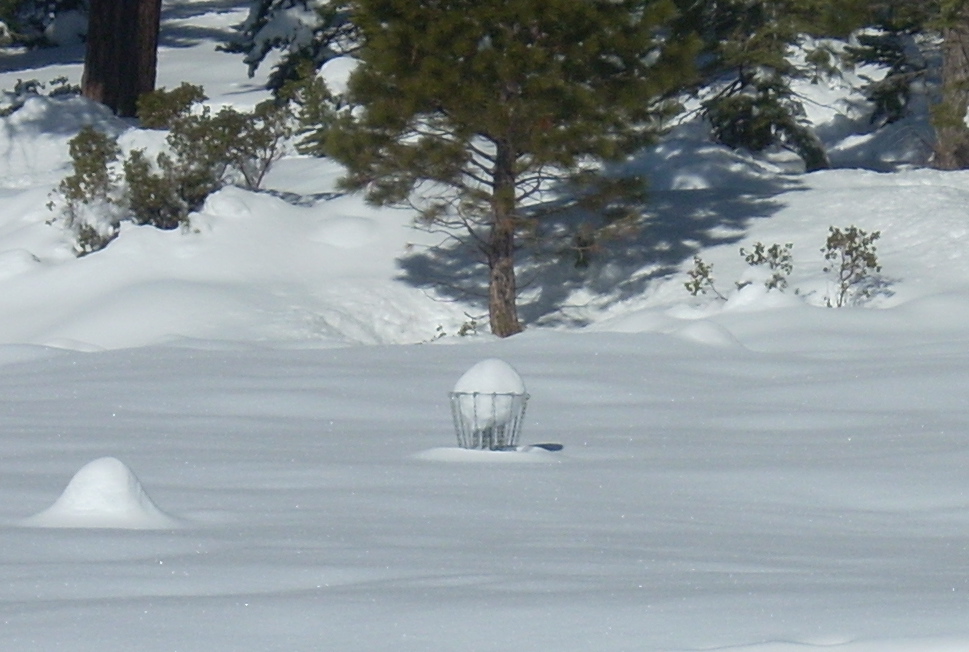
Baskets seem to find me
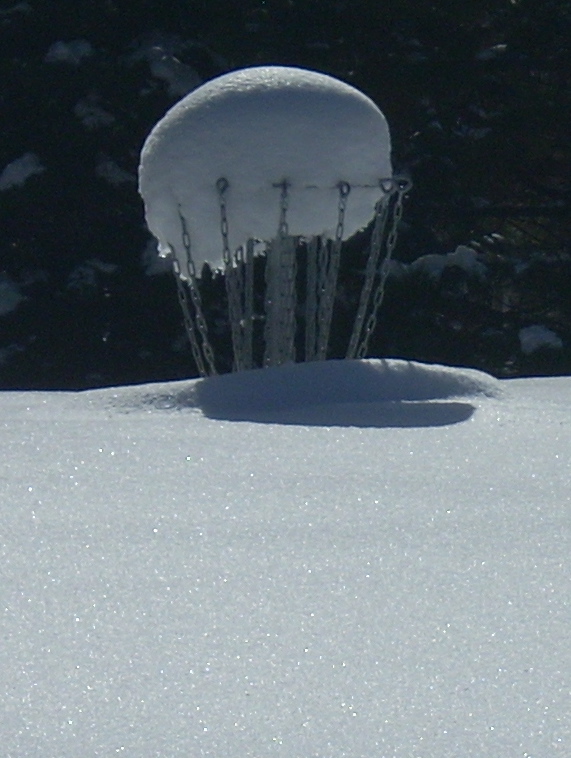
Took the family to Tahoe recently, and one of our goals was to find a great place for sledding. We were pointed in the direction of a hill at North Tahoe Regional Park. True to the suggestion we received, the hill was great for our kids for sledding. But I also received a nice surprise when I spotted first one snow-covered basket,

then another,

and finally one right near the hut where we paid to go sledding (don’t know how I missed that one when we first got there- must be slipping).

I inquired with the guy in the hut, and sure enough he had one disc (a beat-up DX Stingray, which I assured him was valuable as a roller and finesse turnover disc) for me to borrow. I tried a few putts with ski gloves, and a few with frozen digits. Not sure how those in other parts of the country manage to play their Ice Bowls. No whimps, no whiners indeed! Anyway, I checked it out on line, and apparently the course at the North Tahoe Regional Parkis quite challenging and fun. I’m on a mission to get back there in a warmer month and play all 18.

Anniversary of the Hambrick Day Ace

I’m not really a ‘rare’ disc collector. My home office has more than 30 discs on the wall (plus the single framed Marty Hapner created Masters Cup composition-of-many-years’ stamps disc remaining in my house), but nearly all of them are really valuable only to me. There are the discs from tournaments I’ve won, tournaments that stick out from other reasons, and there are a few ace discs. I haven’t meticulously preserved all my aces discs, though, because – as I’ve said before – most of my aces have been accidents, when it comes right down to it. I was trying to nestle it up close for a birdie . . . and . . . ching! A nice surprise. Sound familiar?

But I do have one ace disc that might be more than an accident, and that disc caught my eye just now. Stan my go-to man when I want to know potential collector value of a disc, tells me it’s maybe worth $40-$50 because it’s an 8-time KC Pro Cheetah in almost mint condition. But probably not, because in Sharpie on the front is written “Ace!, Hole #8, 8/14/97, 3:40 PM, and on the back, in Sharpie also, are the signatures of my playing partners that day- Brad Schick, M. Schick (his Dad), Brian Schick (his brother), and ‘DJ,’ a friend of theirs.

I was taking advantage of a business trip to play in an Ohio supertour (Hall of Chains Classic) on my way to the Am Worlds in Wisconsin, and decided to stop by and play the famous Hoover Dam course. As it turns out, on that day a memorial was being installed next to a tree planted a year earlier to honor the memory of Brent Hambrick. For those that didn’t discover disc golf until recently, Brent was the local legendary driving force of the sport’s growth before being cut down by cancer. There was even a camera grew from a local TV station setting up to cover the dedication of the memorial as we approached the tee.

As it also turns out, the Schick’s and DJ were close friend of Brent’s, and they grew quiet as we prepared to tee off. When it was my turn, I asked where the basket was since it was blind from the tee. They informed me that I wanted to throw around 250 feet up the wide-open, then cut the disc to the right, down into a protected green. I selected the aforementioned Cheetah, let fly based solely on their description, and heard the unmistakable sound of agitated chains. The guys got almost tearful rather than the usual yelling and high-fives, which is understandable given their connection to Brent Hambrick and the fact that the memorial was being dedicated that day. But get this:

  • The hole, #8, was well-known to be Brent’s favorite on the course
  • My home course is DeLaveaga, well-known to be his favorite course. The Masters Cup was also his favorite tournament. He traveled from Ohio numerous times to participate
  • I am left-handed, and Brent was left handed
  • The Cheetah I threw had never been thrown before, by me (I had never even thrown ANY Cheetah before) or anyone else. In fact, that trip from my (and Maybe Brent’s) hand to the basket was the only flight it would ever make.

Add those things together, and it’s no wonder my group reacted the way it did. Yes, I threw a disc I had never thrown before on a hole I had never played to a basket I couldn’t see . . . but it was no ‘accidental’ ace.