beacon disc golf

Lost Disc Anxiety No More: A Review of the Beacon Disc Golf Tracker

Every disc golfer knows the frustration: You throw a perfect shot only to watch your favorite driver disappear into the woods or tall grass. Fifteen minutes later, you give up the search, your great round disrupted, and your bank account slightly lighter. Fortunately, The Beacon Disc Golf Tracker is here to solve that problem, as long as your round isn’t in a PDGA-sanctioned event. But don’t let that major caveat immediately write of the Beacon.

Based on my testing, I can confirm that the Beacon Disc Golf Tracker works exactly as its creator 2014 – a seasoned product designer, engineer, and avid disc golfer – claims. It has two essential functions that it performs well.

A close-up view of the Beacon Disc Golf Tracker, featuring a black circular body with a red button and the word 'BEACON' embossed on the top.

Once the button is pressed, it emits a clear beep every 10 seconds until it is pressed and silenced again. Furthermore, the attachment process is secure; once affixed to a disc using the supplied adhesive ring, no impact or scrape is going to knock or pry it off. And the device won’t turn on if the battery is too low, so assuming you remembered to turn it on before throwing, you’ll find that disc.

This product very effectively solves a universal disc golf problem: the inability to retrieve a disc you can’t see. If that disc has a Beacon tracker attached, simply walking within the vicinity should allow you to hear it.

Key Features and Functionality

  • A Clear Signal: The tracker emits a clear beep every 10 seconds.
  • Range: You can easily hear your Beacon up to approximately 100 feet away.
  • Universal Fit: It attaches to any disc or plastic type.
  • Durability: The device is Water-Resistant, capable of handling rain, wet grass, and brief dunks in water.
  • Customization: It features four unique sound settings to match your preference.
  • Battery Life: The easily replaceable CR2016 battery lasts up to 100 rounds.

Technical Specifications

  • Weight: Approximately 7 grams (~7g).
  • Size: 1.41 inches (36mm) diameter and 0.28 inches (7mm) height.
  • Attachment: The Beacon uses 3M VHB double-sided tape specifically designed to attach to disc plastics.
An exploded view of the Beacon Disc Golf Tracker, detailing its components including the intuitive UI, replaceable CR2016 battery, two screws for battery access, and ultra high bond 3M VHB tape.

Who Needs Beacon? My Verdict on Utility

I believe the Beacon tracker will be a huge addition for casual disc golfers. For recreational players who hit the course regularly, the $15 price point (or less when bought in packages of 3 or 6) makes a lot of sense. These players might consider attaching trackers to most of their discs, reasoning that this will dramatically reduce their lost disc rate. This results in savings of time spent searching, money spent replacing discs, and a reduction in FDSA (favorite disc separation anxiety).

During testing, I quickly discovered a new experience while watching a disc I just launched soar into thick, overgrown brush and trees: Calm. I knew I wouldn’t be losing a disc, taking a lost disc penalty stroke, or spending time fruitlessly peering into dark spaces, armed with nothing but hope. This elimination of anxiety, even if it is only mild anxiety, kind of defines the word priceless. Recreational players (who, by the way account for the majority of all players) are out there to relax and have fun, after all!

(Top and bottom pics of my tester disc)

I can see some rec players sticking Beacons to all or most of their discs and eliminating one of the only detractions of this glorious, accessible sport. But for players who like to compete in PDGA events it’s a little more complicated, as PDGA rules prohibit anything being attached to a disc.

Also, while I believe the creator’s claim that the small device doesn’t noticeably alter a disc’s flight for most, it seems mostly directed at concerns about the device messing with the balance of the disc. In that he’s correct; I didn’t notice anything that looked weird or off axis about the disc’s flight. If a sophisticated player is used to throwing a technical shot with a 173 gram disc, though, and now that disc weighs 180, the formula for that technical shot is going to change. That hyzer flip will require a bit more speed or a slight angle or release point change, for instance.

The large majority of regular players don’t execute on that level and won’t notice the weight difference much, and this product is still quite useful in certain circumstances for all disc golfers (Golfers who DO notice a difference should be able to adjust):

  1. Exploring New Courses: They are ideal for road trips where you are playing courses for the first time and won’t be able to return later to possibly retrieve lost discs.
  2. Practice Rounds: They are paramount during practice rounds before a tournament, allowing players to efficiently learn the holes without losing key discs.
  3. Local Trouble Spots: They can be used on those holes on your local course that always pose a high risk for losing a disc.
  4. Snow rounds and glow rounds: Get rid of the ribbons and experience night rounds in a whole new way!

Get Yours Early: Kickstarter Campaign Details

The company website is http://beacondiscgolf.com/, but Beacons won’t be for sale anywhere except Kickstarter, and only until November 22nd. After that you’ll have to wait until early next year to get one. Don’t wait! $15 isn’t much to support a disc golf entrepreneur and check out a potentially (disc golf) life-changing product.

If you’re still on the fence, the Beacon Disc Golf Tracker was engineered by Kevin Glennon, a product designer, engineer, and avid disc golfer who previously spent eight years developing outdoor grills and electronics at Weber. And I noticed Kickstarter gave the campaign a “Project We Love” endorsement seal. So I think your investment is safe!

If you want to be among the first to feel that new, wonderful sense of calm when a drive goes rogue, the Kickstarter Campaign is open now.

Please come back and comment if you give it a try. Let us know what you think!

The Ultimate Hi-Top Disc Golf Shoes: Idio Brawlers Explained

After testing Idio’s new hi-top disc golf shoes for nearly a year, I can say I love them and recommend them. The video below explains exactly why.

As noted in the video below, I was pleasantly surprised by the Idio Syncrasy Brawler. Not because of the quality or waterproofness, as I expected as much based on my experience testing previous models, and I was right. The Brawlers remained completely waterproof even after exposure to rain and deep puddles. Nothing is wearing quickly or coming apart in the least.

The surprises I am referring to both stem from my preconceived notion that hi-top disc golf shoes would be heavier, and stiff, like hiking boots. I found them to be lighter than expected and responsive on both tee pads and uneven terrain.

The other surprise is more like a bonus, as it is the one benefit missing from the hi-top’s marketing material. But I noticed it and don’t mind sharing.

The high-top collar is comfortable but still very form-fitting, so it effectively keeps out not only water, but also dirt, rocks, sticks, and thorns that can get into low-top shoes and cause distractions and delays.

Please check out our review on YouTube and subscribe to the channel, @schoolofdiscgolf

Durability is another key thing to report as the shoes held up well after nearly a year due to harder composite materials.

Listed below are some key technical details:

Key Features and Technologies

Adapt-A-Brace: The Adapt-A-Brace compression collar provides ankle support without restricting movement. It features special cutouts in the back for flexibility. The laces go all the way to the top for a secure fit.

Waterproof Sympatex Liner: The Brawler utilizes a Sympatex waterproof liner, offering breathability and sustainability. This liner works through a physicochemical principle, transporting water vapor molecules to the outside via hydrophilic molecular chains. The membrane’s molecular structure swells with increasing humidity, dynamically adjusting the space for water vapor transport.

Improved Durability: Idio Sports has addressed wear issues in the front of the shoe by hardening the material and re-engineering the lugs. This enhancement ensures the shoe remains effective for disc golf.

Dig Toe: An overbuilt curl around the toe protects against wear and tear, eliminating the need for frequent repairs.

Lace Pocket: The shoe includes a stash pocket for the laces, keeping them out of the way.

Image captured from Idio’s website.

Sustainability

The Sympatex membrane is recyclable, contributing to sustainable outdoor clothing production. Sympatex aims to close the loop by producing recyclable membranes.

Final Thoughts

The Idio Syncrasy Brawler is a top-tier disc golf shoe that should develop a loyal following. A reasonable portion of disc golfers would prefer a hi-top design for various sensible reasons: The terrain where they play, the extra ankle support they provide, and wet and cold conditions. With their comfort, durability, and waterproofing on top of a handful of very real disc golf-specific design elements, the Idio Brawler should be a hit with competitive and recreational players alike.

techdisc disc golf measure your throw

Unlocking Your TECHDISC, Part 1

As a coach, I am always on the lookout for better ways — sometimes just additional ways — to help clients understand key points. Being able to reliably measure the forces applied to a thrown disc is a seismic shift in this regard.

After working directly with dozens of clients using a TECHDISC—some in-person at our facility, others remotely, using a TECHDISC they purchased—I don’t hesitate to recommend the product and platform to everyone. I’ve witnessed the impact it can have within a single 2-hour introductory lesson. Remote coaching (video conferencing, chatting) instantly becomes 50 percent more effective when the client has a TECHDISC in their hands that produces data on my screen.

I have a disclaimer, though. My perspective is undoubtedly skewed. My experience with TECHDISC has thus far been through personal use, and as an instructor. As a user, I began with an advanced understanding of disc characteristics and throwing mechanics, and my clients, through working with me, have access to that “interpretative” knowledge as well. For others, unlocking the true benefits of TECHDISC might not be so automatic.

It reminds me of when I discovered creative apps like Photoshop or Garageband. In both cases I was excited at the potential to create art and music, only to discover that there would still be tons to learn about the products and the media upon which they were designed. I was daunted by the learning curve required just to get started.

Using a TECHDISC is simple. Download the app, connect via Bluetooth, throw the disc, and flight numbers appear. Using a TECHDISC to get better at disc golf, however, is not so different than an artist or musician learning to use the aforementioned apps from scratch.

This is the first of what will likely be a series of posts intended to help fellow disc golfers unlock TECHDISC. The plan, to avoid bogging down with lengthy technical discussions, is to touch on several different areas in each post, including:

  • Exploring the platform— Capturing and viewing throw data is only the tip of the iceberg
  • Understanding the numbers as interlocking components of disc flight
  • Applying that understanding to the confident creation of the ideal combination of disc, throw type, and throw-type details (the stuff measured by TECHDISC) —something that must be done in less than 30 seconds, again and again.
  • Going from “knowing what to do” to “How to do it” to “I’m doing it!”

If readers ask specific questions in the comments or by contacting me directly, I’ll do my best to address them in the next post.

Before starting, I want to draw special attention to the last bullet on that list. If you buy a TECHDISC, read the rest of this post and the others in the series, feel you’ve gotten a good handle on the first two bullet points, but still struggle with the 4th and maybe also the 3rd and therefore see no measurable difference on the course . . . don’t be discouraged.

Read our reviews on the site or Google Maps and you’ll see a repeating theme beyond the generous compliments; people of widely varying skill levels and experience who only needed to work 1-on-1 with an expert who can tailor the lesson to their needs. If that is the last piece of the puzzle left to be able to throw to your potential, why not? Think about it, and in the meantime let’s begin our deep dive into TECHDISC.

when to use The App and when to use techdisc.com

A disc golf disc with a TD (short for TECHDISC) puck attached to it can interact with the TD platform in two different ways; by connecting it via Bluetooth to techdisc.com on a web browser, or to the iOS or Android apps. Don’t think of it as either/or; both methods have their uses.

Connecting your TECHDISC through a browser has the benefit of universality. Pretty much anything that can get an internet connection, has Bluetooth, and isn’t ancient can connect to your TECHDISC, if needed. But that’s not where the web interface shines, just a nice backup plan in case the app isn’t available.

One person throws the TECHDISC while the other holds a smartphone with the app open.

Logging in to your account at techdisc.com is where the research takes place, compared to the app and disc, which are used to collect specimens (throw data) out in the field. Whereas the app easily connects to the disc and clearly displays basic information (along with another killer feature), the ability to dig deeper, experiment, and search for patterns exists only on the web platform.

Digging Deeper

View the list of your throws at techdisc.com, then click on one of them. You’ll see one important stat (Advanced Ratio) that doesn’t appear on the app display. This number is a calculation of spin rate and speed, and a good indicator if you are achieving enough spin for your armspeed and disc choices. You’ll also see 3D mapping based on their computer model’s projection of the throw’s flight path. (Since there are numerous external factors their model can’t take into account, don’t get too hung up on what it looks like.)

Experiment

Regardless of whether you think the 3D graphic looked like your real throw or not, clicking on it opens the secret passageway to a virtual laboratory where you can play the What-If game two different ways: Change around the flight numbers of the disc to see how the flight of your disc changes when you use a slower, lighter, or less stable disc, for instance.

Change the actual measured Throw Details of the throw being displayed to see the various ways—and what would be required, effort-wise—to get the disc to move in the direction you desire. If a throw with your current driver’s flight numbers dumps to the left, up the spin rate until it flattens out for longer, or lower the launch angle, or both.

Searching for Patterns

The longer you work with TECHDISC, the more useful the collected data becomes. This is especially true if you proactively use the platform’s ability to add tags and a note to each throw. TECHDISC automatically assigns backhand/forehand and hyzer/flat/anhyzer designations, but you can add more info. For instance, #afteraround to see how fatigue affects your form, or #cold, or #windy, or various specific discs.

More data points + more throws over time = more potential revelations about how score better through improved insights.

The App

The iOS app has been out for some, but the Android version was released more recently. I mentioned one big feature of the app aside from its simple function and optimized display, and here it is: If you want to work with your TECHDISC and know the results of each throw without having to look back to a screen, you can! Simply set the app up to audibly read out the measured stats of your choice. This works great when you’re working on something specific and use the stats as instant confirmation of whether you’re on the right track.

Spin vs. Speed

I have had similar experiences lately with three of my clients who own their own TECHDISCs. In each case, I have for some time been stressing the importance of imparting enough spin on a disc to enable it to fly as intended. I’ve done my best to explain why throwing shots with more spin and less speed allows a player to gain additional precision when needed and achieve steep turnover shots that cover short distances.

They all listened. Each of them embraced the mechanical changes we made, stressing a crisp halt of the body on drives to increase snap. Somehow, though, it became clearer—and therefore more of a priority—through the use of TECHDISC.

  • Seeing the RPM (spin) number increase when you work on a mechanical change specifically intended to increase spin is for some a more concrete form of evidence than seeing the difference in flight because memories fade but numbers are forever. Or something like that.
  • As noted above, the Customizer can be used to see how increasing spin changes flight “in the lab.”
  • TECHDISC provides a calculated metric called Advanced Ratio which describes the ratio of speed to spin rate for any given throw. It is Speed divided by RPM multiplied by the circumference of the disc. For a typical throw, an optimal ADV ratio is in the mid-40s, and this provides a simple benchmark, regardless of speed or distance.

I believe that as with many things in a sport as complex as disc golf (they say it’s easy to learn and hard to master) half of learning new skills and tricks is gaining a deep enough understanding of that element of the game. As I explain in Three Paths to Better Disc Golf (and touch on in this blog post) there are six ways to manipulate the flight of a disc. Six knobs to adjust, if you will, to get the exact flight you want. Spin is one of those knobs.

If I have a low ceiling on a 200-foot shot and need a throw that turns over at the finish, I’m probably better throwing an understable disc with a hyzer nose angle and use extra spin to create the turn, rather than releasing with anhyzer, due to the low ceiling.

My clients seem to be grasping these concepts more clearly thanks to TECHDISC, and that has given them more motivation to work on spin-inducing drills. Whether you own one or not, you can still use the Customizer to see why spin is such a crucial component to getting the flight paths you need and the distance you crave.

Hit me up with questions and I’ll do my best to answer them, and might include some in the next TECHDISC post.

Idio Syncrasy Disc Golf Shoes: So Far, So Good!

update: The 2024 Idio Syncrasy disc golf shoe is now available!

disc golf shoe on sale, best disc golf shoe.

When I first saw an ad for the Idio Syncrasy disc golf shoe during a Disc Golf Network broadcast last season, I thought the timing was sublime. I happened to be shopping for new disc golf shoes just then. After 20-plus years of searching for the perfect “shoe to use for disc golf” (a true disc golf shoe did not yet exist) the search for my most important piece of athletic equipment was once again wide open.

Although I’ve yet found the perfect disc golf shoe, I had until recently refined my personal preference to waterproof trail running shoes. Hiking books, even supposedly light ones, feel too heavy and restrictively rigid. But where I play, I genuinely need water resistance and shoes that can handle all types of surfaces. Lightness and comfort are must-haves, as well. When you add up my time teaching, practicing, and playing, these shoes will be worn for long hours at a time.

I had gone through two pairs of my most recent iteration, from Brooks, and they were okay but ultimately failed in the way so many others had. They all wear out in one place while the rest of the shoe has plenty of life. So when I watched that ad and right away noticed how they are built up in areas where so many disc golfers’ shoes always break down, the timing was right.

For now, I can tell you this shoe was designed from scratch specifically for the sport of disc golf, as opposed to every other shoe marketed as a disc golf shoe in the past. In all those cases, the marketing was the ONLY thing disc golf-specific about the shoes.

Well, for me, anyway. The end of the ad stated they were taking preorders with delivery months away. I needed shoes right away, so I settled on a model from a top running brand I hadn’t tried yet: Sauconys. They’re okay, so far, but if the pattern holds they’ll start to crumble under the demands of NorCal disc golf any day now.

Not long after that, as luck would have it, the opportunity arose to review the Idio Syncrasy shoes here on the blog. I of course jumped at the chance, wanting these shoes to be what I and so many others have long awaited.

Idio Syncrasy’s fit in perfectly at the quirky, quixotic (and legendary) DeLaveaga Disc Golf Course.

That was a couple of months ago now, and a (rather understated) summary of my opinion at this point is, ‘So far, so good.’ Since durability and water resistance are important factors for me when choosing a disc golf shoe, I plan to revisit this review at least two more times to let you know how they’re holding up. However, after 15 rounds on courses with cement, turf, and natural teepads in some pretty challenging conditions I’ve already collected plenty of intel. All of it points to a recommendation to buy the Idio Syncrasy.

The price tag of $130 seemed reasonable, since that is about what I’d been paying for waterproof trail runners. But Idio just lowered the price to $103.20 for a limited time. That is quite a discount for a shoe that in my opinion is a good value at full price.

Before I go any further, I should share details about this shoe’s unique, dare I say idiosyncratic, features. Disc golf-specific things like:

  • Drag-on toe protection
  • X-flex zone in the sole for “Natural transitions for powerful drives and saucy jump-putts,”
  • High-rise midsole to help your plant foot hold fast
  • Power Plant heel
  • Larger toe box.

You’ll read more here in the future as each of these features carries a story of its own, but you can delve into the technical details right now at Idio’s website. For now, I can tell you this shoe was designed from scratch specifically for the sport of disc golf, as opposed to every other shoe marketed as a disc golf shoe in the past. In all those cases, the marketing was the only thing disc golf-specific about the shoes.

With that in mind, consider the features I just listed out. Each began with a blank slate and reams of information about what disc golfers want and need in a shoe. There are a variety of priorities out there, and with the Syncrasy, Idio is attempting to address them all.

I have to admit that for me, the promise of a shoe designed to resist the specific wear to the toe that teeing off can create – Idio calls it “teebox rash” – was enough to get me to bite. I remember my years as a pitcher in baseball, attaching metal plates and Shoe Goo to prevent a very similar fate. Then the shoes arrived, and it was one surprise after another.

At the end of the first wet DeLa round, the Syncrasy’s were wet and crusted with mud, but my feet were dry.

In the ad, the look of the shoes made me think of them as specialized athletic equipment in the same way as rock climbing shoes do. Just a bit exotic, and built for a specific purpose. When I got them on my feet, though, they looked less blocky and utilitarian and more sleek and, well normal. If you end up wearing these other places besides the disc golf course, you’ll look marvelous (as long as you clean them up a bit).

Another big surprise was the combination of comfort and performance. The surprise had nothing to do with me starting out skeptical about Idio being able to deliver on both fronts. I spoke with the owner/designer and came away extremely impressed by his capabilities. Rather, it had to do with assumptions I made after I put the shoes on for the first time but before I played my first round in them.

First off, these shoes are way lighter than I expected. To look at them, I thought they were a hybrid between trail runners and light hiking boots, and that made me think they’d be heavier – “clunkier” – than I like. Not so! Every time I pick them up, I notice how light they are.

Putting them on, I was struck by the way they felt very secure at the top of the shoe but almost too roomy inside in the front (the toe box). If I was asked in general “How do those shoes feel?” I would have said right away they felt great. They did. They do. But it seemed almost certain that that comfort would come at the price of performance.

One of the first tests of the Idio’s off-the-fairway chops took place on a mountain course that had just been reopened after being untouched for 2 years. No slips, no turned ankles!

By the time I got to wear them out on the course I had forgotten about this fit issue, likely because my feet quickly acclimated to this uniquely designed shoe on the walk from the car. I received no trepidatious warning signals that my footing wasn’t to be trusted. That’s a good thing, an essential thing, because my full drive requires tons of trust as I plant my anchor foot and count on it to hold fast. If I was hesitant right from the start, the shoes would not have received a full test and any drives launched would be severely compromised.

I didn’t think about that issue again until the end of the round when I began to formulate this review. I realized that not once while playing a very rugged mountain course did I feel like I lost balance or traction due to my feet moving around inside the shoe (or for any other reason). In a future review I’ll get into shoe lingo a little (very little, probably) to explain how this is possible in more technical terms. For now, though, I can say they protect my feet and by extension the rest of my body like stout footwear designed solely for that purpose, but feel like comfortable walking shoes the rest of the time.

Water Resistant?

The middle of hole 16’s fairway at DeLaveaga provided a great test of the Syncrasy’s water resistant upper. This shot required me to submerge the shoe past the tongue, and my foot remained dry.

As to the water resistant qualities of the Idio Syncrasy: I threw LOTS of water at these shoes, and they resisted all of it. You may have read about the storms and flooding in California in January 2022. I played in steady rain a couple of times for hours at a clip. Each time, when I checked my socks afterward, they were completely dry. I even lowered one shoe as far into a deep puddle as I dared without allowing water to pour in through the top.

Time will tell more, and like all athletic shoes no one expects the water resistance to last forever. But in one of my key areas I can report: So far, so good!

User Feedback

At this writing, the Syncrasy has 388 ratings on the Idio website, with an average of around 4.5. That’s a decent sample size, but I find face-to-face testimonials much more useful. Right after ordering the shoes I began to notice people at my local courses wearing them, so I started asking for opinions.

I did not hear one single negative comment, and common themes were “comfortable,” “lighter than I expected,” “great traction,” and “so far, so good.” I didn’t get down on the ground to conduct a super-close inspection, but from a few feet away I detected no visible signs of early wear or shoddy craftsmanship. Granted, none could have been older than 6 months, but I spoke to seven different people, and the consistency of their answers is noteworthy.

It seems pretty likely Idio managed to nail down good quality control right from the start. Also, if any of the company’s disc golf-specific design elements were a big swing-and-miss, I believe one of the folks I spoke to would have noticed already and called it out. The word on the street: So far, so good.

summary

Time will tell whether the Idio Syncrasy lasts significantly longer than the parade of trail running shoes I’ve tried. We’ll know more as the months wear on. After a vigorous trial period, they’re showing no signs of distress.

Aside from the built-up toes, the other disc golf-specific features are difficult to judge. I’ll learn more as I delve into each with the shoe’s creator in future posts. It’s clear that the roomy toe box, X-flex zone in the sole, and high-rise midsole work together to create that unique combination of comfort and control. I experienced it first-hand. If you’re the type of person who loves or needs to learn exactly how and why, stay tuned for future updates to this review.

If you’re in a similar situation as I was last year, watching DGN and looking for my next disc golf shoe, I’d say it’s a no-brainer. The Idio Syncrasy is a genuine disc golf shoe that is well-built and designed from scratch for the sport of disc golf. (Update: I typed those words before noticing the price of the shoes has temporarily dropped from $130 to $103.20.)

If you just bought a pair of something else (like me when I saw that ad on DGN), stay tuned. I’ll be adding updates here as the test goes on and I glean more info from Idio.

This post may contain affiliate links, which means I may receive a small commission, at no cost to you, if you make a purchase through a link.

Rovic Disc Golf Cart

I’m going to share my thoughts on the Rovic disc golf cart from PAS Disc Golf (I like it), but first I’d like to broaden the topic a bit and present a matter-of-fact, bullet point-style case for why some disc golfers choose to use a cart. Then – assuming one of the reasons resonates with you – I’ll explain why you should consider using a pushcart (Rovic) rather than a pull-behind cart (Ridge Roller, Zuca.) NOTE: It’s been pointed out to me that Zuca and Ridge Roller carts can be pushed as well as pulled but to me the two-wheel and ‘stick’ handle design elements don’t lend themselves well to pushing over and around obstacles.

Five reasons for using a cart in disc golf

  1. Less strain on the body- In most circumstances pushing (and to a lesser extent, pulling) a load results in far less stress and fatigue on your body than carrying it ‘beast of burden’ style on your back. On top of that, carts (some more than others- see below) reduce the strain of bending over to retrieve and replace discs from a bag on the ground.
  2. Carry more discs ‘n stuff- This argument works in reverse if you’re only carrying five discs and a water bottle, but the average disc golf-obsessed individual likely carries at least 15 discs in addition to all manner of accessories. The more you carry, the stronger the argument for using a cart when possible (see #1).
  3. Good built-in seat- Both styles of cart provide the option of a built-in seat that is better than the three-legged stools (which can also be a pain to carry and stow).
  4. Better in the rain- Setting aside the advantage of umbrella holders for now, the simple fact is carts mean not having to constantly plop your bag on the wet ground then sling it back over your shoulder(s). As it gets wetter, it gets heavier, and you get wetter.
  5. Another way to spend money on disc golf- Disc golf, on the whole, is exceedingly affordable, leading many players to happily spend the money they save by not having to pay to play on surplus discs and every cool accessory available.

On the flip side, the most obvious reasons for not using a cart is terrain that makes it more trouble than it is worth (If a course is mostly steep slopes and/or rocky and rutted surfaces, for instance), having to transport it to the course, and cost.

four reasons for using a pushcart

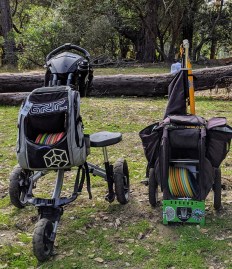
Discs sit about a foot higher in the Rovic, and that means less strain on back and knees. and check out that cool seat!
  1. Much better to push than pull- Others may feel differently, but I don’t like having to stretch an arm behind me and pull something along on wheels. It’s just not comfortable and I don’t like not being able to see the wheels as they encounter obstacles.
  2. Discs sit higher- With three-wheeled push carts my discs sit higher than they do in a pull cart, providing easier access and less bending over.
  3. Maneuverability- The three-wheel design is more stable, and by lifting either the front wheel or back wheels of the ground I can easily navigate through most uneven terrain.
  4. Ball golf example- The Rovic is based on the design used by ball golfers for many decades. There’s gotta be a reason golfers have stuck with it all these years, right?

At this point, I should say I went into this review wanting to like the Rovic. You see, I’ve used the same makeshift disc golf cart for more than a decade- a BOB baby jogger designed for offroad use. When the pull-behind crates hit the market I never once considered buying one for the reasons listed above. But the pull-crates did have one feature I envied; the more compact size that enables them to be easily transported. My baby jogger folds up, but not small enough that I can fit it into my already crowded trunk. I had to lift it awkwardly into and out of the back seat of my compact car every time I used it.

My take on the rovic disc golf cart

I was excited about the prospect of having the on-course functionality of my baby jogger in a more stowable design, and I was not disappointed. It takes a few reps to get the setup/breakdown routine down, but it now takes me less than a minute to unfold the cart and attach my bag. For me, that is more than reasonable given the benefits the cart provides. Folded down it measures only 24x15x13 inches!

You can see how small the Rovic folds down with a standard Grip bag next to it. The car is a 2009 Honda Civic, and the trunk is pretty small. It takes up less space than a ‘crate’ style cart.

Backpack-style disc golf bags attach to the Rovic in three places, providing a very secure rigging. You can also simply hang your bag on the upper hooks and it won’t fall off, but it will swing from side to side when the cart is in motion. Use the extra straps if you want to avoid that.

The position of the standard umbrella holder keeps rain off you but leaves your bag exposed. Nevertheless, it keeps your hands free and is a cool standard feature.

The Rovic comes with some useful accessories, like an umbrella mount, a storage box with a secure snap-closing lid, and a large drink holder. They also sell some optional goodies as well. Some of the most relevant to disc golf include:

  • An adapter that allows the angle of your umbrella to be adjusted
  • A phone holder
  • A cart seat

I ordered the seat, and find that it works nicely. It allows me to sit up a bit higher than a three-legged stool, and the way it works is quite nifty (yeah, I said nifty). It includes a spring that keeps its footpad off the ground until weight is placed on it. When sitting on it the weight is on the seat, not the cart.

Rovic disc golf cart
The Rovic cart works great on my home course, the hilly and fairly rugged DeLaveaga Disc Golf Course.

So far I’ve played more than a dozen rounds using the Rovic, nearly all of them on a very hilly and wooded course (DeLaveaga in Santa Cruz, CA). It has performed wonderfully and been especially appreciated during and after the rain when my bag stays off the wet muddy ground. The ‘parking’ brake only engages on one of the two rear wheels, but it’s enough to keep the cart in place even on a steep slope.

I used my Rovic while securing a victory in the recent DeLaveaga Disc Golf Club Match Play Championship, and one of my playing partners told me he’s had one for a year with no issues. I expect mine to hold up for years of steady use and recommend it to others without hesitation.

Bottom line: If you want to use a cart in disc golf, go with a three-wheel pushcart. From there the choice is simple. Those with a tight budget but plenty of transport space can get by with a used baby jogger. Otherwise, treat yourself to a Rovic.

Disc Review: Vibram O-Lace

For me, the Vibram O-Lace fulfills more than four years of eager anticipation. It is the disc I’ve been itching to have in my bag since the first time I held a disc made with Vibram’s X-Link rubber compound in my hand.  Before I get to my full review, though, please indulge me by first reading a little history:

When I got to throw Vibram putters for the first time, part of my initial reaction was ‘the grip is fantastic. I can’t wait to see how the midrange discs and drivers perform when they come out!’

When the Ibex, Trak and Ascent were released, I liked them all, and asked Vibram Disc Golf head honcho Steve Dodge when they would have a long range driver. He explained that Vibram was methodically releasing discs on a regular basis, focusing on having a disc model for each category and sub-category within a couple years. I found the Ascent to be very useful as a stable fairway driver and the Trak as a versatile midrange/fairway driver finesse disc and roller. But I dreamed of throwing a long-range, fast, strongly overstable driver with the grip and ‘grab’ of the current models.

The updated Vibram flight chart

A few months later the Obex arrived in the mailboxes of us testers, and I loved it (and still do). It had all the stubborn stability I hoped for, with unusual forward glide for a disc that stable. That satisfied me for a little while, but we always want more, don’t we? I again inquired about a long range driver with the same qualities, and was patiently and politely reminded that it was coming, in due time.

Fast-forward to the release of the Lace, Vibram’s first long range, high speed driver. It quickly earned a permanent spot in my bag with its ability to go very, very far on just about any line I gave it, but I still yearned for a version that could handle ridiculous combinations of power and anhyzer angle. I said as much in my feedback to Vibram after testing it, and based on the next prototype I received, six months later, their response seemed to have been ‘be careful what you wish for!’

After the release of the Lace, Vibram sent us two models, one which resulted in the UnLace, and the other a disc easily more overstable than any I had ever thrown before. That thing had practically no glide whatsoever and seemed to almost fight the anhyzer angle I tried to give it before it even left my hand, like two strong magnets of opposing polarity. Ok, that last part was probably my imagination, but you get the picture.

I must not have been the only tester who felt that way because when the production model of the O-Lace came out -much like Baby Bear’s porridge, chair and bed – it was just right.

The Vibram O-Lace is a fast, very overstable driver. And while it doesn’t break through any barriers in terms of its speed or stability it is nonetheless a breakthrough disc.

Side view of the Vibram O=Lace

There are a couple characteristics all Vibram discs have in common; first, the rubber compound provides a grip that is superior to any plastic blend, and it also tends to skip less or at least not as far. Second, the the stability-to-fade/glide ratio tends to be better as well. By that I mean that compared to other discs there isn’t as much of a tradeoff between stability and glide. The overstable discs in the Vibram lineup don’t fade as quickly as you’d expect for discs that can handle power the way they can.

All of these factors are present in the O-Lace, and that is why I consider this disc so special.

Think about it: the fastest drivers are normally the hardest to throw and typically involve the most extreme effort on the part of the thrower. What better time to have a sure, reliable grip? And which discs tend to get away at the end of the flight due to a sharp fade? Just check the flight charts. The answer is fast, overstable drivers, of course. But the O-Lace is notably different.

When I took mine out to Pinto Lake, where the holes in the upper meadow all have fast fairways and OB lines left and right on every hole, that difference was remarkable. Thanks to that grip I felt I had full control as I put it through its paces. It handled both low flat screamers and big power anhyzers, always ending with reliable fade at the end. It netted just as much distance as any other similar disc in my bag. And probably the most useful feature on that course where discs so easily skip-and-slide out of bounds was the way it bit and stopped quickly even when landing fast on a sharp edge. I was able to throw much more aggressive drives on those open but dangerous holes, knowing that my disc would not skip fast and far on the hard terrain- unless the shot was designed to do so.

There is only one thing I don’t like about the O-Lace, and this goes for pretty much all Vibram discs: The variegated (definition: exhibiting different colors, especially as irregular patches or streaks) coloring of Vibram discs create two annoying problems. First, any disc that is not one solid, bright color is harder to find on the course. If you play in an area with lots of rough this is an issue. Second (and this is more of an annoyance than anything else), when you go to pull one of these discs out of your bag you naturally look for a disc of the predominant color on the disc. But if it has a different color on part of its edge, you may forget to look for that color as well and wonder why you can’t find the disc you’re looking for. I assume Vibram does the multi-color thing as a distinguishing design factor, but I’m hoping they someday soon give players a choice of solid or variegated coloring.

My suggestion is to try a Vibram disc if you haven’t already. And if you have room in your bag, consider an O-Lace for the unique qualities I’ve described. Sometimes you want that long skip, but just as often you don’t.

All things disc golf. Dot com.

This website serves as the home of School of Disc Golf, a disc golf instruction and event organization based in Santa Cruz, CA. To the broader disc golfer community we’d like to think that we’re also a good source of instructional and opinion posts. As stated in our mission statement, School of Disc Golf “strives to provide the  information and resources necessary for organizations and individuals to embrace the sport of disc golf in healthy and meaningful ways. Our ultimate goal is to inform as many people as possible about the numerous benefits of disc golf.”

We seek to reach the largest audience possible, and to that end have in the past also published posts at RattlingChains.com. The partnership has worked well for both sites, but in keeping with our mission statement (‘inform as many people as possible about the numerous benefits of disc golf’), we’ve decided that change is in order. We thank RattlingChains for a great run together and wish them nothing but the best in the future.

Moving forward, School of Disc Golf posts will appear at the rapidly expanding All Things Disc Golf. This site is the undisputed leading disc golf blog in terms of page views and unique visitors, and until now its content has consisted mainly of product reviews and Q&A interviews. The new affiliation of School of Disc Golf is only one facet of All Things Disc Golf’s expansion that will add instructional content, feature stories, increased tournament coverage, and contributions from several talented graphic artists. You can read the detailed announcement here.

We’re excited to be part of a larger effort to reach the masses with the great story that is disc golf, and as always School of Disc Golf will continue to also focus on helping those who already love the sport improve their skills, scores and enjoyment.

Disc Golf Unchained video game coming soon- and you can help

Stop me if you’ve heard this one before: Someone announces the development of a breakthrough disc golf video game and claims it will be far better than the paltry offerings available today. Maybe they even forge a partnership with a major disc golf entity. Then either the excitement fades away as quickly as it sprouted up, or the game does get released but falls short of all the hype.

We’re hearing this once again, and this time I have a hunch it’ll turn out differently. And I can point to a few specific reasons why I feel this way.

Local Route Labs in the enclave of Madison, Wisconsin has announced its plans to release a disc golf video game for the Android and iOS platforms mid-year 2014. The company – which at this point consists of two avid disc golfers with full-time jobs outside of this project – launched a Kickstarter campaign that provides plenty of evidence of the work they’ve done thus far. It also leaves one with the impression that their game, Disc Golf Unchained, is definitely gonna happen.

For one thing, developing the game for Android and iOS first is a great decision. Far more people have access to devices on these platforms than the various consoles. And those who are not normally ‘gamers’ can easily make an exception by downloading the game to their phone or tablets in minutes.

When I asked co-founder Tyler Krucas why he and business partner Adam Heier decided to invest thousands of hours and a not insignificant amount of personal funds in a disc golf video game, he said it had to do with the “lack of disc golf video game options on the market,” adding that “the options that are currently out there also seem to leave something to be desired.”

Frankly, that is a familiar refrain from would-be developers and frustrated gamers alike. But then he began to expand on that answer, and the more I heard the more I became convinced that assuming it makes it to the market and is stable this will truly be a breakthrough game.

It wasn’t just the detailed shortcomings of previous disc golf games that Krucas recounted and pledged to address: taking the shortcut of building the flight engine on that of a ball golf game, producing flight not realistic for a flying disc; throwing disc golf as an add-on to a game that includes a collection of sports, more as a novelty than anything else.

Others have made similar claims before along the same general lines. But I hadn’t heard details like I do from Local Route Labs, and more importantly, seen proof of how they are addressing those details.

It became obvious pretty quickly that these guys are familiar with the nuances of disc golf. They understand the desire of advanced players to have a large selection of discs from which to choose that perform as they should. Disc golfers want to be able to throw backhand, forehand, and tomahawks, and they agree. They’re even trying to figure out how to add rollers! When you throw a big anhyzer with a stable disc the right way, they want you to be rewarded with a sweet S-turn.

As far as courses go, the plan is to have some real, familiar ones built in, and also some created just for the game located on terrain disc golfers dream of tackling. From the screenshots and video clips on the Kickstarter page both the foliage and the undulations of the playing surface look pretty good. And one feature they are particularly excited about is a built-in course engine and editor. “We think the inclusion of real world courses will be a big draw,”explains Krucas. “and allowing players to create their own based off their favorites will add another level of engagement. We definitely look forward to seeing what our users create with the Course Editor and hope to eventually make them available for everyone.”

If you’re someone who is into both video games and disc golf, are eager to see ‘real’ disc golf take another step in its inexorable climb to relevance as a sport of the future, or both, I encourage you to do two things:

  1. Check out their Kickstarter campaign. The funding period ends December 3rd and they provide participation options as low as $1 and opportunities for cool things like being able to sponsor a hole on a permanent course in the game- complete with signage.
  2. Spread the word through social media, and encourage your disc golf friends to do likewise. In particular, post on Facebook pages for disc golf clubs where the highest concentration of disc golfers will see it.

I’ll post on this game again with a full review when I’m able to test it out. If I had to bet, I’d say this game is gonna happen next year, and it’s gonna be good.

Disc Review: Vibram UnLace

When I started playing disc golf there was no such thing as ‘premium’ plastic. All discs were of the grade we now think of as standard (Innova calls theirs DX). For those who have thrown nothing but the ‘good stuff’ (most players who have taken up the game more recently and can afford the good stuff, you likely missed out on a great developmental tool.

You see, low-grade plastic discs become steadily more understable the more they’re used and inevitably whack trees and other hard surfaces. So that favorite stable driver of yours would become a little less stable over time, than even more ‘flippy’, and finally it would want to turn over all the time. But smart, observant players wouldn’t throw it on the scrap heap. Yeah, they might replace it with a new, more stable driver, but they’d leave Old Faithful in the bag because A- by then they’d become very familiar with its flight characteristics, and B- it would be able to perform a neat trick: start off as a low of mid-height hyzer, then flatten or even turn over a ways down the fairway. If you’ve ever (as a righthander) played a hole that is a low tunnel shot for 150 feet, then requires a a throw that turns right at the end. you know how useful this can be. Especially if your sidearm is less reliable.

Which brings us to the Vibram UnLace. For more accomplished, bigger-armed players, it’s a turnover disc that when thrown with the proper touch and finesse can be made to do all kinds of neat tricks. And the best part is that, unlike those old beat-in standard plastic discs from the pre-Climo era, it’s made of durable (read: indestructible) Vibram rubber. That means it won’t change once you’ve gotten used to it and learned how to get it to do those neat tricks.

I’ll admit that I’ve had it in my for a couple weeks now and still haven’t quite figured out the exact blends of power, hyzer, and line to get it to turn just when I want- but these things take time. Another plus is the better grip that rubber brings. That’s even more important when throwing touch shots.

I haven’t had time to get to know the UnLace like I hope to, but I’m a strong believer in the greater flexibility of understable discs when it comes to crafting mind-blowing, creative shots. I look forward to getting to know this baby and really learning what she can do.

This review also appears as part of a review over at RattlingChains.com. The approach we take for reviews on that site is to have three players with different levels of expertise review each disc, so hopefully readers get the perspective of someone with a game similar to theirs. You can read the full review here.

Product review: DGA Elite Shield Disc Golf Bag

After using the DGA Elite Shield bag for more than a month, it gets my endorsement as my favorite bag ever as well as in my opinion the best accessory product ever marketed by Disc Golf Association. Time will tell whether it passes the all-important durability test, but it seems to be very well equipped in that regard as well.

DGA Elite Shield disc golf bag

It should be mentioned right at the beginning that one’s preference of disc golf bags – like the golf discs they are designed to carry – is a highly subjective matter. Most significant in this regard is size. Some prefer the minimalist approach: a bag that is as small as possible and meant to hold a few discs and maybe a small water bottle. Others represent a rather different philosophy, and represent the “If there is even the remotest chance I might need it, I want to carry it” school of thought. These folks want to carry 30+ discs, two wardrobe changes, enough food and water to survive in the wilderness for 10 days, and seven miscellaneous pockets and straps full of ‘other stuff’.

I prefer something between these two extremes. I want room for around 14 discs, a large water bottle, and the outer layer of clothing I’ll remove halfway through the round. Several convenient storage pockets for my snacks and little stuff, too. And now that I’ve gotten used to backpack-style straps, my bag must at least include that as an option as well. Finally, I’d like to keep the cost reasonable- under $75.

Obviously not an overly large bag, the DGA Elite Shield nevertheless easily holds 16 discs with plenty additional storage room.

So keep in mind these personal preferences when I say that the Elite Shield bag by DGA is the ideal bag for me. Now, on with the review!

The company is best known for its dominant share of baskets installed worldwide and its pioneering status in the sport (perhaps you’ve heard of ‘Steady’ Ed Headrick, PDGA #001, Father of Disc Golf, inventor of the Pole Hole catching device), but also markets its own line of discs, apparel and accessories. They try hard to innovate in everything they do, and this bag really hits the mark in that respect and many others as well. In fact, there are so many cool features included on this bag  – a couple which are completely unique to the Elite Shield – that I’m going to list them bullet-style, along with impressions after a month’s worth of use.

  • Shield Pocket- This is the stand-out feature for which the bag is named, and it’s a hard shell storage compartment designed to keep a phone, sunglasses, or anything else you want to keep from getting broken or wet safe and sound. DGA general manager Scott Keasey told me he got the idea after watching a bag (turns out it was HIS bag) get backed over by a car. I’m not sure it would withstand the weight of a car, but I love having a place where I know my breakables will be safe. Like most great innovations, it’s simple but brilliant.
  • Gel Foam back padding- I’ve personally never had an issue with my bag feeling ‘hard’ against my back, probably because it comes into contact more with my backside than my back. Still, the padding is quite cushy and I can notice the difference.
  • Retractable Towel Lanyard- This is a detachable device that consists of a clip that attaches to a hook inside the large side pocket on one end, another clip that attaches to a towel, and a length of strong but skinny string that automatically retracts back into the device. I didn’t know at first whether I’d use this, but find that I like not having to deal with stuffing my towel back into the bag after using it. I’ve never used towel clips before because they required me to use the towel right next to the bag- which is awkward. Now, thanks to the lanyard I can have my cake, eat it too, and not worry about losing it (the towel I mean, not the cake).
  • PVC diamond-plated water resistant bottom- This is actually a biggie for me, as I play in pretty rugged terrain and the bottom of bags here is usually the most likely failure point. Most bags are not only made of the same material as the rest of the bag, but are completely flat as well. The Elite Shield’s bottom is rugged plastic, and also includes ‘feet’ that keep the bottom surface slightly elevated to reduce exposure to moisture and other wear-and-tear.
  • Foam insulated beverage pocket- My favorite parts of the beverage pocket are elastic gather at the top which keeps even my small aluminum bottle secure, even when I’m running, and the mesh plastic bottom. I hate it when my bottle leaks for whatever reason and I discover a pool of liquid accumulating in the holder. The mesh will prevent that from happening. One small downside is that a large Nalgene bottle is a tight fit. The fit is actually nice and snug and not too tight, but getting it in takes some wrangling.

Using the included customizable dividers, 14 discs fit snugly in the center of the main compartment, providing easy access to the discs in the middle and ample room for towels and clothing on either side.


The more standard features of the bag are all quite agreeable as well. It comes with a skinny should strap, but the four well-placed connectors accommodate the backpack straps of your choice. DGA sells it packaged with their Gel Strapz, but I attached mine and they work perfectly.

The storage pockets aside from the Shield pocket are all I could ask for One large zippered compartment and another small one outside of that, with a couple small ‘tuck’ sleeves outside both for a mini, pencils, or whatever (The smaller one fits my School of Disc Golf cards nicely.

The putter pocket presents one small drawback for me, but only because I will sometimes jog during and between holes on the course when time is tight. I keep two putter in the pocket, and a couple times now the one on the outside has popped out. Absolutely no concern if you’re walking on the course like most people, but speed golfers be aware that this might happen.

You can see from the images above that this is a medium-sized bag. I personally have room for 12 discs in the main compartment in addition to the two in the putter pocket, and using the included configurable dividers the discs sit neatly in a middle section, with storage in both side-corners of the main compartment for clothing, extra towels, etc. This bag can obviously hold many more than 14 discs. In fact I recently met a guy at a local course that recognized me from the TV show, and I noticed he was using an Elite Shield bag. When I told him I’d be reviewing it soon, he said he was able to fit 30 discs! Way more than DGA intended with the design, but it gives you an idea of the capacity.

DGA’s website – with the enviable URL of discgolf.com – includes a great gallery of pictures of the Elite Shield bag. It lets’s you see the bag from every conceivable angle.

If like me and Baby Bear you prefer a bag that isn’t too small, or too big, but just right, and also includes a bunch of cool extras, and is also designed to last- yet doesn’t cost too much, I think you’ll like the DGA Elite Shield bag.