College Disc Golf, Air Force Disc Golf in Japan, Jack Tupp on Amazon, and the Ground-Up Approach to SAving Strokes.
Last week in the wind-whipped world of disc golf, the College Disc Golf National Championship went down pretty much as expected. WPI (Worcester Polytechnic Institute) finished a respectable 8th, between Kentucky and Texas A&M. Meanwhile, Lenexa, KS finally opened a course 20 years in the making. Officers at the Yokata Air Base in Western Tokyo did not blink, and within days announced their own new disc golf installation.
Meanwhile in the world of School of Disc Golf, aka, Play DisGolf, Inc., aka, me, I was surprised to learn my book Three Paths to Better Disc Golf is only two ratings shy of 100 on Amazon. (I had no idea! You see, I’m pretty shall we say “hands off” when it comes to my social media marketing — eh-HEM, Slacker! — and not as up-to-date on these things as I should be.) If you’ve read the book, post a review and help it hit triple digits!
I want to share a few snippets from past reviews as feedback like this is extremely gratifying and humbling at the same time.
“I did not expect how many of the suggestions just clicked – reflections of things I know to be true from my work and personal life that I had simply never applied to my recreational passion – disc golf. So far my scores are trending in the right direction, but more than any of that, practicing “disc golf in a vacuum” has allowed me to enjoy my time on the course even more. Highly recommend!”
“This is an awesome read, Being new to the sport I was a little confused about some aspects of the game. The author makes great sense and is simple to understand. If you take your game seriously you owe it to yourself to check it out.”
“I’ve read several of the most popular disc golf books and this is by far my favorite. Excellent treatment of the subject and from someone who can actually write!”
Those were some of my favorites, each for a different reason. I even liked the lowest-rated review, which simply said “Be the Disc, Danny.” An association with one of the best movies ever can’t hurt, right?
I also have deep ties to Michigan Disc Golf (what’s up, WinniCrew?), and this campaign to build an epic course and honor a legend is a perfect example of why and how disc golf has come so far and ain’t slowing down! Help ‘em out if you can, especially if you’re near the Upper Peninsula.
Our private course is showing signs of a mini-super bloom, and the season for teambuilding events and group activities is getting started. Contact me directly if you’re interested in booking a date or learning more.
Hole 7, looking back to the tee.Basket of Hole 5 in the Hazard Island location.
This week’s flashback post from the blog is a 2-Parter. Big mistakes can obviously cost you big-time, but lots of little things can add up fast. Knowing how to adjust to the vagaries of the terrain, or taking a Ground-Up Approach to Saving Strokes is key.
Part 1 focuses on up/down and left/right slopes, while Part 2 addresses varying tactics based on varying playing surfaces. Just to tie this week into a neat little bow, these are also chapters in that book I mentioned.
May your weekend include time to throw discs and enjoy their flight.
World record in nz, disc golf lingo, disc golf philanthropy, and the march madness winning coach practices disc golf?
Last week in the warm, furry underbelly of disc golf, a new distance world record was set. Seven year old Sarah Wadsworth of New Zealand launched their disc 62.07 meters, or a little more than 200 feet. Sources are unclear on whether it was a chuck or a huck.
According to Udisc, Morley Field in San Diego is the most-played disc golf course in the world. After an improbable run SDSU last week lost to UConn in the NCAA men’s basketball title game. According to these fools UConn coach Dan Hurley practiced disc golf right after the game, but he’s really just tossing . . . you guessed it . . . a Frisbee.
This week’s flashback is to a post about disc golf lingo— one of my most popular ever. It’s also a chapter in The Disc Golf Revolution, right between “The Complexities of Disc Flight” and “Disc Golf on the Road.”
Loudoun County must be LOCO about its disc golf community.
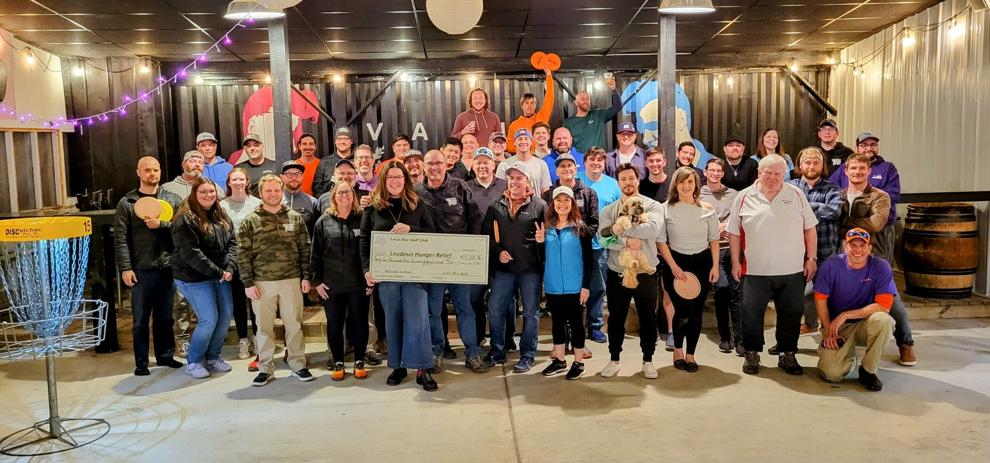
Local disc golf clubs like the Trumbull County Disc Golf Association not only routinely provide the necessary labor and funding to build new courses (go to Play Discgolf on Facebook and search #newdiscgolfcourse to see a ton more). They also raise funds for the community, and every winter clubs around the world host “Feed the Hungry” events. Shout out to the LoCo Disc Golf Club in Loudoun County, VA, first off first the cool spelling of your name, but also for being a shining example of disc golf’s philanthropic nature. 40k is not chump change, and they do it again and again!
Playing early morning rounds has always been part scheduling necessity for me and part preference. The course always seems more beautiful and dramatic at first light. And speaking of drama, my favorite arch nemesis is back, and he wants my tag!
Hole 2 long at DeLa: Do NOT miss your line.
DeLaveaga is set in The Long for the upcoming Masters Cup, and pretty much every hole requires skill, precision, and nerves of stainless steel.
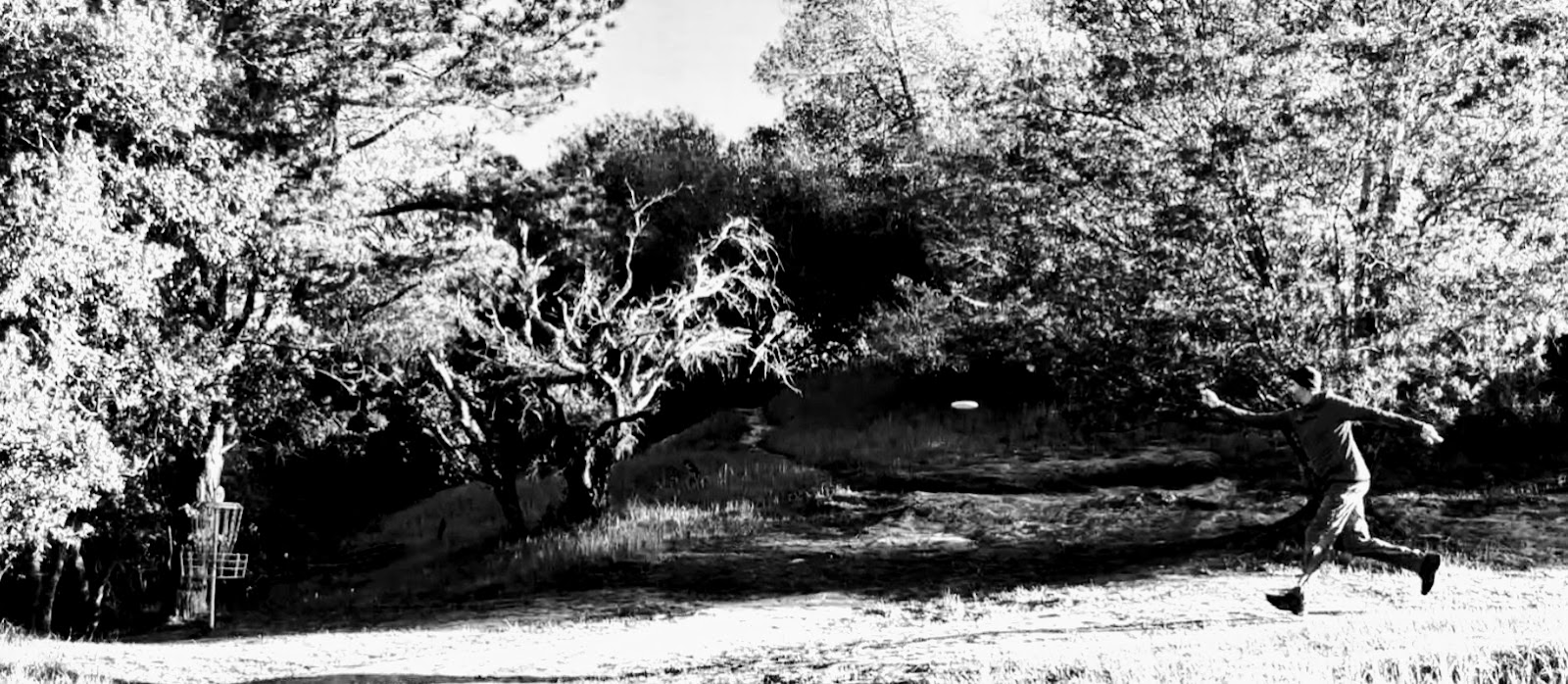
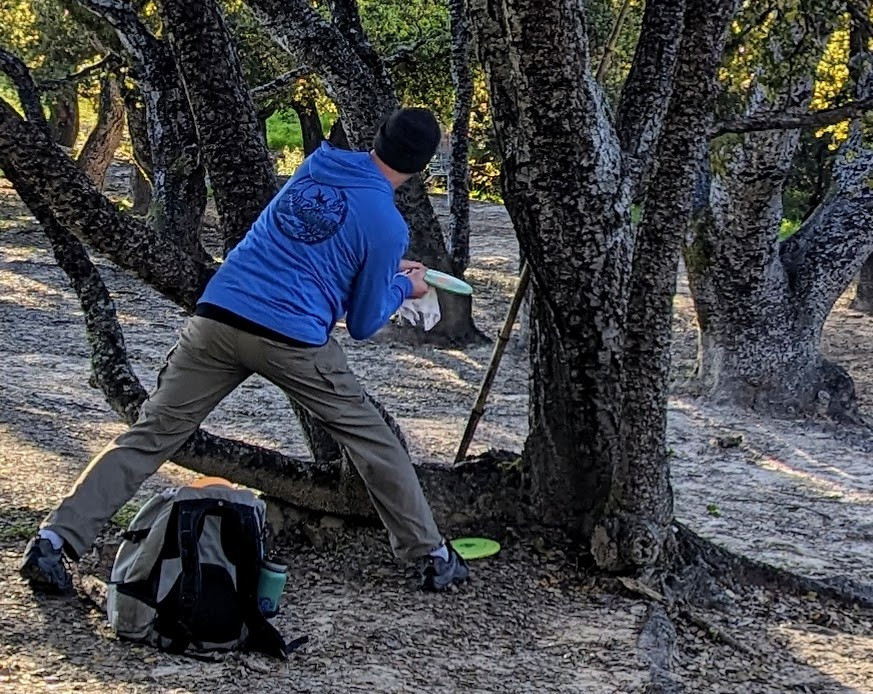
This scrubby oak on hole 4 at DeLa is known as the Catcher’s Mitt, and that drive was most definitely a strike.
Enjoy your weekend, especially any disc golf you get to play. It’s a gift!
I’ve received a few queries asking why a newsletter that usually opens with a line about the wide world of disc golf is called FrisbeeGolf Friday. There are numerous reasons that I will share over time, but let’s start with two. The first can be defined as onomatopoeia. The word frisbee sounds like what it is, which is extra cool when you consider that is was selected rather than created.
In the History of Disc Golf chapter in The Disc Golf Revolution, I ask which sounds better: “Let’s go play flying disc,” “Let’s go play Pluto Platter,” or “Let’s go play Frisbee!” When most of the world thinks flying disc, it thinks Frisbee, which is my second reason for the newsletter title. I am publicly asserting that the word frisbee (notice I didn’t capitalize it) has become a genericized trademark. Want proof? Google “frisbee golf” and see what comes up.
For those who didn’t know, the only reason our sport was called disc golf in the first place was basket inventor and PDGA founder Ed Headrick’s need to respect WHAM-O’s trademark and branding. If the word frisbee is no longer protectable, I say, say it. Frisbee Golf!
A guy in Utah found healing in disc golf, so he came up with a way to pay it forward. The Breaking Chains group in Taylorsville, UT is part support group, part fresh air and exercise, two things crucial to those battling addiction and mental health issues. The founder hopes to expand in Utah and then nationally.
In Wadesboro, NC students of Anson High School’s sports and marketing class will be organizing and running an upcoming disc golf tournament.
Photo courtesy of Peter Ascuitto
I’m writing a post right now with the working title of “Less is Less,” the idea being that you can shave strokes off your game by doing less on any given shot. Watch for that soon, but in the meantime here are a couple from the past that also touch on the idea that we can lower our scores by playing smarter as well as playing better.
Both are also chapters in my book Three Paths to Better Disc Golf. Get a signed copy from me here, or get it on Amazon.
I wrote last week about the value of a midrange that anyone can throw straight, citing the Wombat3 as the best example.
Wombat3
Earlier this week I aced hole 8a at DeLa with my Star Wombat3, a short, tight hole I’ve played thousands of times but never aced. The only reason that disc found the chains last week was because it kept pushing forward when my other discs all faded at the end. It was a nice surprise and perfect illustration of how this disc is different.
Short, tight holes often require straight-flying, slow discs.
That’s it for this week. Get out there and have fun!
Last week we found lots of good stuff in the cracks and crevices of the disc golf world. The 2023 World Happiness Report came out, and get this: The top spot goes to disc golf-crazy Finland; the top 10 include more leading disc golf nations; the top 20 “happiest” countries all have disc golf.
Draw your own conclusions.
Ads for the Austin, TX chapter of the First Tee program ran during last weekend’s Disc Golf Network broadcast. I found that interesting. First Tee is a ball golf-based youth program where participants learn life skills along with golf skills. It is run by the World Golf Foundation, the trade organization for the golf industry.
Ads for the Austin, TX chapter of the First Tee program ran during last weekend’s Disc Golf Network broadcast. I found that interesting. First Tee is a ball golf-based youth program where participants learn life skills along with golf skills. It is run by the World Golf Foundation, the trade organization for the golf industry.
When researching my book, I interviewed the WGF’s then-executive director about the possibility of First Tee including disc golf in its programs since disc golf is so much more accessible. She made it clear that the golf manufacturers who funded First Tee would not let that happen. But that was in 2015. Maybe this is a sign of things to come- or maybe the head of the Austin chapter of First Tee received a stern phone call. In any case, the Revolution continues . . .
Speaking of DGN, kudos to the producers for making better and better use of the drone cameras. Getting that “5,000-foot” perspective really makes a difference.
Our #newdiscgolfcourse spotlight of the week comes from Quincy, IL. David Morgan, director of golf at the Westfield Golf Center, said “They (disc golfers) don’t have a long course in the area apparently, and so now they can have competitions and stuff like that.” Do they not have golf tournaments in Quincy? It reminded me of this great moment from Corporate Spokesperson history after Madison Bumgarner and my SF Giants won the World Series. Good “stuff.”
Here’s a quick tip. A truly straight-flying midrange disc is useful for maybe more than you think. If you’re challenged to get a disc to turn in a certain direction, sometimes it’s better to throw a shorter (or longer) straight shot than force it. The Wombat3 is a perfect choice for this purpose because it goes straight and finishes straight regardless of power, even if released with hyzer. If you can’t make that tight dogleg, play station-to-station instead. If you have trouble hitting low tunnels, a Wombat3 is good for both.
A client recently gave me this really cool gift, a handcrafted mini disc that features pressed alder seeds. I have no business relationship with Treasures of the Forest– just wanted to share them with my readers. Judging by the site, their stuff is in demand, but they add pieces each week and take custom orders that can include organic material you send them! Check out their Facebook page, too.
If you missed last week’s FGF, I shared a new instructional post on optimizing the use of eye-body coordination and mentioned I had an upcoming tournament. I won the tourney, and employing the eye discipline discussed in the post was a major reason why. Check it out!
Before you return to your own daily “stuff,” please take 60 seconds to sign this petition. The already semi-approved course would be in a part of the Bay Area that has no disc golf (how can they be happy?!), and the site is fabulous. Thank you!
Last week in the wide world of disc golf, another brave disc golf club declared its intention to turn straw into gold– and you can help! I particularly like the idea of converting Bellingham, WA mall dwellers into disc golfers. As the Disc Golf Revolution continues, disc golf is expanding into a new market- New Market, Alabama, to be precise.
From Taupō, New Zealand we learn of the North Island Championships, where more than 200 players will compete. I love this uncredited image from the story, and that basket! The chain assembly looks solid but the cage appears ready to break some hearts.
Due to shipping costs, disc golf course builders in more remote locations need to create their own, locally-produced baskets.
——-
My extended test of the world’s first real disc golf shoe continues, and they’re holding up great. Check out my first three months’ review– if you want to give them a try, now is a great time. In honor of Women’s History Month, Idio is knocking $44 off the regular price of $129.99.
——
Watch. Where. You’re. Throwing! The latest instructional post on our website is about the role our eyes play when putting and driving, and it can be summed up with those four words. Learn how to best use these powerful pieces of human technology.
Our new booking site is also a great place to pick up unique disc golf gifts and merch- or it will be soon. There’s not a lot there yet, but you can find some clearance items you won’t find anywhere else. There is even a shirt from the show Discmasters that I hosted with Nate, Val, and Avery back in 2011.
Wish me luck this weekend as I compete in the Enduro Bowl at DeLaveaga. It’s 58 straight holes (2×29 holes), and the course is bound to be a slog.
My 2019 Enduro Bowl trophy was this cool ring. Go Team!
How to focus on your goals. literally. with your eyes.
Summary: Making full use of your eyes can dramatically improve the aim and consistency of your drives, your putts, and all throws in between. Read on to learn Why, Where (as in, where your eyes should be in any given situation), and How (as in, how to make any necessary changes).
Merriam-Webster defines the term eye-hand coordination as “The way that one’s hands and sight work together to be able to do things that require speed and accuracy (such as catching or hitting a ball).” Or tossing a disc at a target.
After watching my recorded analysis of his driving form, a remote client in New York replied that the issue with keeping his eyes glued to the ground throughout his drive was a habit borrowed from his days playing ball golf. In that sport keeping the head down makes sense. The spot on the ball where the club will ideally make contact is where the eyes need to be in order to do their job.
In disc golf, however, looking down makes no sense at all. Nor does directing your eyes anywhere other than the aiming target. Trying to watch the disc throughout the reach-back or trying to observe some other part of their form are both also popular practices among clients when they first come to me. In all of these cases, the eyes are not being used as they should.
It’s pretty simple, actually: Eyes locked onto a target are sending the brain information that is useful for aiming; eyes looking anywhere else are not. “Wandering eyes” contribute nothing to successful execution. Eyes focused on the wrong thing send information that conflicts with the brain’s understood objective and are often the sole reason for errant shots.
What are you looking at? Watch where you’re going. Watch where you’re throwing!
The website Cognifit.com further defines eye-hand coordination as the eyes perceiving information (visual-spatial perception) that the brain then uses to guide the hands to carry out a movement. We use our eyes to direct attention to a stimulus and help the brain understand where the body is located in space (self-perception). The broader term motor coordination refers to the “orchestrated movement of multiple body parts as required to accomplish intended actions, like walking.”
Or launching a disc golf disc at a target 400 feet away. Multiple body parts, including the eyes, must coordinate to perform even routine disc throws.
To fully grasp the significance of where our eyes are pointed during every millisecond of a disc golf throw, it helps to think of the human brain as a very powerful computer and our various body parts as software and hardware. I provide a couple of comparisons below specific to driving and putting, but the principle is the same:
Your eyes collect information required for proper aim and balance. Prolonged focus on the right thing maximizes their contribution on any given throw.
those driving eyes
For the neural phenomenon of motor coordination to work best, the eyes need to be focused where they can gather the info most useful to perform the task at hand. When driving this will usually be the basket, but not always- especially on holes with doglegs, elevation changes, or any blind shot that prevents even seeing the basket. Pick something specific, though. This amazing piece of human technology works best when you feed it specific spatial coordinates.
I find it helps to think of eye-body coordination while launching drives in disc golf as if I’m a jet pilot firing guided missiles at another jet- at least as depicted in movies. I first”acquire” the target in my sights, meaning I start by locking my gaze on my aiming point- forward, level with the horizon. As I start my footwork, I remember to “lock on” to the target using the motor coordination connection between my eyes and other body parts. The better I can maintain that connection, the better my aim will be.
At this point, I trust the technology and”fire,” doing my best to keep the target in my sights as continuously as possible throughout the throw. On a full-power throw it is usually necessary to momentarily pull the eyes away from the acquired target. That’s okay, if the extra distance you’ll get justifies the broken eye-body connection. Just remember that having your eyes focused on the target 85 percent of the time is way better than 15 percent of the time, and still much better than 50 percent of the time.
I grabbed the below images from a video of Paul McBeth posted a year ago by Tom Manuel. I agree with Bro Heme who in the video’s comment section said that McBeth is the “best combo of power and accuracy in the game.” He (Paul, not Bro) knows exactly when and how to sacrifice a little aim to get the needed power.
Image 1 shows McBeth already locked onto his target. That’s the default, and his eyes won’t leave until Image 4, when turning his hips and shoulders away from the target makes it impossible for them to maintain contact. Note that even then, though, his chin touches his throwing shoulder rather than pointing back in the same direction as his shoulders. If you could see his eyes, you’d see they are rolled to the right in their sockets, straining to re-establish the eye-body neural connection as soon as possible.
By Image 5 – before the disc has left his hand – McBeth’s head is back in position for his eyes to gather and transmit fresh data critical to shot execution. In Images 6 and 7 we see him making an effort to keep his eyes locked onto the target through the release of the disc. This ensures that the contribution of the eyes is maximized and has the additional benefit of helping prevent him from pulling the disc off his line due to imbalance.
Simply by the orientation of his head you can tell that this player is looking at the target in all images above except 4 and possibly 5, at which point his eyes are just reacquiring the target.
Standing at the front of the teepad and focusing your eyes hard on the target before beginning your throw won’t accomplish the same thing— even if you extend the disc dramatically while staring. If you do that, then stare at the ground next to you throughout your throw, or let your eyes passively drift wherever the alignment of your shoulders takes them, the target is no longer acquired, much less locked on.
If you are learning or re-learning the footwork that most like to pair with a full-effort backhand drive, first of all, ask yourself whether that’s a good idea at this point. Assuming the answer is yes (and even if it’s not, yet), you have a couple of much better options than trying to watch your feet or the disc to confirm whether you’re doing things correctly.
You can film yourself and then self-analyze and/or get help from a pro. If you must use your eyes to learn, this is the way to do it. Your eyes already have an important job to do during the throw, and unless you are a chameleon or a four-eyed fish, your eyes can’t multitask.
Learn by feel. Pay attention in detail to what it feels like to keep your eyes straining and neck craning toward the target as you twist your torso away. Learn to stay center-balanced through any footwork, then check the video to see how you did. How does it feel when you do it right? Simply focusing on the feeling of success and failure during and after your throw will help you refine and repeat.
Note: As you see in Figure 5 above, a full-turn drive requires momentarily breaking eye contact with the target. When this is the case, it is important that you don’t wait until your eyes reacquire the target to begin your throw as that would waste the large muscle power of your reach-back and screw up your timing. Instead, learn to treat that fraction of a second when your eyes are forced to come off the target as a blip of static, with the picture returned before you know it. During that blip, the “feeling” you’ve learned will bridge the gap.
the putting trance
Everything I’ve written so far about using the eyes to “throw” a flying disc applies to putting as well. In fact, it’s all magnified! The margin of error on putts is thinner and sharper, and that makes a difference in two ways.
Putting requires exacting precision. Miss by a few inches and you miss the putt
Putting is an unambiguous pass/fail proposition that invites extra mental baggage
Be The Tripod
If the challenge of keeping eyes on the target while driving is like locking onto a 500-mph target while traveling 500 mph yourself, proper eye discipline while putting is like photography with a tripod. The goal is to focus on the exact best place for you to aim (a link of chain, the orange tape) and retain that perfect visual connection through the release of the disc.
Physically this is easier than the eye discipline required when driving. There is way less movement going on (jet vs. tripod), and at no point are you forced to rotate your neck away from the target.
With putting it’s often the mental part that is more challenging, because of the pass/fail thing. It’s easier to get ensnared in anxious thoughts about the results of the putt when there is no gray area. Letting the eyes drift away from the target to the disc is common in this case, sometimes before the disc even leaves the hand.
Even when you’re on the side of a mountain in the Andes surrounded by llamas putting at a makeshift basket of a thin tire and thinner chains, maintain focus with the target. Photo by Jeff Faes.
Breaking visual contact with the target even a fraction of a second too soon can cause a bad miss. To prevent this, lock your eyes onto your aiming point and try to keep them there until the disc reaches the target. As much as possible, keep your head still as well. Think of a picture taken right as the camera gets jolted. Blurry, out of focus. It’s why tripods exist.
The next time you practice your putting (today, right?), focus on your “eye-work.” Are you aiming at something small and specific? When I am in a period of poor mental focus I will sometimes realize I’m aiming at the target in general. Be intentional about your aiming point, on every putt.
Do your eyes stay locked on that aiming point, or do they “unlock” as the disc leaves your hand so you can track the progress of your attempt? I struggle with this in particular, and I’m not sure whether it is due to being emotionally attached to the results or my ADHD. Maybe my eyes get drawn to the movement.
Whatever the reason, I know it’s something that requires constant monitoring, and I know it’ll be worth the effort. Science tells me that keeping my eyes focused on the right thing improves motor coordination. My own empirical evidence backs it up.
The takeaway here could not be simpler. Watch where you’re throwing!
Last week in the wide, wide world, the disc golf revolution continued unabated. A promoter in China contacted me about publishing The Disc Golf Revolution for distribution there. A sizeable market to be sure, but I don’t want any confusion about revolutions. The early translation effort needs work, Yao, but thanks!
From Liverpool, England’s first-ever muni golf course (read: old) has a new director (no, not that Matt Bell), and he announced a plan to add disc golf. A bit west of there, the Japan Open, a former PDGA major, is coming in May. This unique event is played with discs 150 grams or less and has been held every other year (or less often) since 1985.
Libraries let you check out all kinds of things. Books, videos, ghost-hunting kits, disc golf kits, birdwatching kits . . . A new course in Lapeer, MI will be funded by a tax on cannabis. I can think of 420 reasons why that makes sense. Speaking of new courses, an overgrown golf course in Indiana is being turned into a shiny new disc golf course, and the city is thrilled. The revolution continues . . .
My test of the Idio Syncrasy has entered month 5, and the epic storms here in Santa Cruz have put the grip and of course the waterproof-ness of these disc golf shoes to the ultimate test. Check out my full review here, and know that nothing has changed. So far, so good!
I’m working on a new instructional post about the role of our eyes in various disc golf throws, so stay tuned for that. In the meantime, enjoy an old post from the blog that connects disc golf, the game of kroits, throwing stars, and “Failure!” Video included.
Last week in the wild world of disc golf, Canadian rodeo grounds became a target for a new disc golf course. According to a story in the Penticton Herald, disc golfers in the British Columbia city helpfully pointed out that disc golf can co-exist with other park users, and also noted that disc golfers happily build and maintain our own courses. Anyone near there should let the Summerland Council know you want disc golf at the Rodeo.
Disc golfers in the village of DeForest, Wisconsin can use your help, too. Proposals by village staff to install a couple of small courses have been under attack by the NIMBY’s, and they are still requesting public comment. Take a minute to let them know how disc golf has been good to you. OK, last one on this theme- maybe things get a little tense up North this time of year, but the town council in North Vancouver is also hashing out a dispute between players and neighbors. If you play on this course, have a calm word with these “few offenders” and let them know how much the course means to you.
unique disc spotlight
Rather than being hotstamped, the design on my first run Rask is part of the mold, embossed in reverse on the underside of the disc so it reads correctly viewed from the top.
One interesting perk of being a disc golf blogger for the past 20 years has been the opportunity to review some notable, ambitious disc models. A great example is one of the first offerings of Swedish manufacturer Kastaplast. Their attempt to innovate in the area of drag reduction to create a faster disc was successful. Even the meathook drivers call the Rask a meathook.
I don’t have much use for this disc in my game (I think it was intended to be Thor’s signature fundraiser disc), but it is a piece of functional art. I tried to capture it’s unique properties in these images.
Viewed from the top of the Rask, we can see the design that is molded into the bottom along with the stucco wall behind the disc.
The feature that makes this disc SO overstable is a raised ridge on the underside of the flight plate. Also on the underside is the disc’s branding, molded in reverse lettering. Viewed from the top of the disc the Kastaplast “K” and other writing can barely be discerned.
This is my type of disc golf disc art, and that inner (lip?) is one-of-a-kind.
pro tour thoughts
The DGPT’s 2023 season opener went down in Las Vegas last weekend. Everyone I know who was there raved about the experience, and it looked great live on the Disc Golf Network- with two exceptions, two headwinds, if you will, pushing against the pro game’s steady progress as a spectator sport.
The first is the literal wind, which can make the game very hard to play- and watch. There isn’t much anyone can do about that, but if you like unpredictable twists and turns and lots of missed putts, windy golf is for you. The other is holding top-level competitions on a playing field designed (and used) for a different sport. Some mention the monotony of wide-open holes when criticizing disc golf on ball golf courses, and I know the practical reasons for using ball golf courses for disc golf events.
My issue has more to do with image and perception, and I have the same problem with disc golf events in multi-use parks. When a person who is already predisposed to not yet take disc golf seriously sees our top level pro hours broadcasting events from what looks to be a temporarily repurposed setting (even if it isn’t), they see it as a confirmation of their beliefs.
When the pro tour has enough options that avoid this issue and still meet required criteria for a strong cell signal and spectator accommodation, look for the sport to soar even higher.
new booking site
Clients have been asking us for a way to book lessons online, and we (finally) responded! Our new booking and ecommerce site, giftofdiscgolf.com, lets users find and book open dates and pay for lessons, purchase gift cards, and get started with remote coaching. Soon it will also have a curated selection of cool and unique merch, as well.
last week’s video
I realized after sending last week’s email that I mentioned but didn’t show or even link to the actual video. Here it is, a nice bit of film making that accurately captures the varied entertainment of playing a solo round of disc golf on a challenging course.
We at School of Disc Golf are pretty excited to have just launched FrisbeeGolf Friday, a weekly disc golf newsletter that caters to disc golfers who love to play the game and grow the sport. You may see the occasional item about a touring pro, but that won’t be our focus.
There are two disc golf targets in this photo. Can you hit those putts?
Please check it out and subscribe. Yeah, we’ll conduct a little marketing as well, but it will be stuff we genuinely think you’ll find useful and relevant.
The look should improve over time, too. But hey, you gotta start somewhere!
MC Flow was not a hip-hop artist, nor a pioneering disc golfer from the early ’80s. He was a psychologist, and no one has ever referred to him by that name except me, in this post.
While researching my book, Three Paths to Better Disc Golf, I learned that Mihaly Csikszentmihalyi is the person credited with the concept of Flow. In the context of athletic performance and contemporary language, “In the Zone” may be the more familiar term for this state of being.
I read yesterday that Csikszentmihalyi (pronounced chik-sent-mee-hai-ee) died on October 20th, a great loss to the academic community. After learning some new things about his teaching and having had a few years to reflect since mentioning him in the book, I decided to once again bring him to the attention of disc golfers who seek the elusive but wholly available nexus of optimized performance and enriched experience on the course.
Csikszentmihalyi was best known to academics who study psychology for his larger body of work exploring happiness and creativity. His codification of the ideal state of productivity, production, and engagement (flow) was his greatest contribution to the larger world’s understanding of the human experience.
Although the concept of flow applies to any long term endeavor that a person wishes to undertake and ultimately master, athletic competition provides the ideal vessel to understand, witness, and hopefully experience this elusive state.
When you think of an athlete being “In the Zone,” what is the first thing that comes to mind? For me it’s a basketball player who is making the right decision at every juncture, making every shot no matter how difficult. When this is happening, we’ll also hear phrases like “automatic,” “unconscious,” and “out of her mind.”
As I have come to understand it, though, flow isn’t a trance-like state where we’re either in it or we’re not- a plane of existence we may be lucky to stumble into once or twice in our lives. It is a target at which to aim, and much like aiming for one center link of a basket, even coming close usually produces positive results.
Csikszentmihalyi (aka MC Flow) used flow to describe a person being in a state of complete absorption with whatever they are doing, of being so involved in an activity that nothing else exists. In an interview with Wired magazine he explained it as “”being completely involved in an activity for its own sake. The ego falls away,” he said. “Time flies.”
If he had stopped there, this insight would still have been fascinating, but not very useful to those of us obsessed with optimizing performance. But thankfully he didn’t stop there.
The actionable crux of MC Flow’s hypothesis is a roadmap on how to get there. To achieve a flow state, he said, a balance must be struck between the challenge of the task and the skill of the performer. If the task is too easy or too difficult, flow cannot occur as both skill level and challenge level must be matched and high; if skill and challenge are low and matched, then apathy results. If the challenge level is high and the skill level is low, the result is anxiety.
This brings me to the main new thing I learned about MC Flow’s hypotheses yesterday, and how it supports my concept of Disc Golf in a Vacuum.
Csikszentmihalyi believed that autotelic personality – in which a person performs acts because they are intrinsically rewarding, rather than to achieve external goals – is a trait possessed by individuals who can learn to enjoy situations that most other people would find miserable. According to the Wikipedia entry on the man and his work, “Research has shown that aspects associated with the autotelic personality include curiosity, persistence, and humility.”
When I had the mountaintop (Top of the World at DeLaveaga DGC, to be specific) epiphany that led to me formulating my own hypothesis on optimizing both enjoyment and performance in disc golf, I was zeroing in on some of the same general ideas as MC Flow. My big personal discovery had three parts:
Immersing myself in the selection, planning, execution, and then evaluation of a shot, solely for the sake of doing so (the intrinsic reward) rather than as a step to achieving a low score on my round that day (an external goal) is the richest, most gratifying way to experience disc golf
Remaining in or close to this state for an entire round almost always results in optimized execution and therefore optimized scoring
Despite being wholly absorbed in each shot as it happens, I’ve found I am much better equipped to go back after the round, often many hours later, and relive the whole round
Csikszentmihalyi listed several conditions for flow, and others have taken it upon themselves to flesh out his hypothesis even further. If you’re interested in the broader topic I encourage you to hop onto Google and dig in. As it pertains to athletic endeavors, and specifically disc golf, I’ll focus on just one: You must be at the balance between the perceived challenges of the task at hand and your own perceived skills.
The first chart in this post may make it seem like you need to be at the far end of both the challenge and skill side of the equation in order to experience flow, but this is not the case. The two simply need to be in balance. Other charts illustrating flow reference the term flow channel, and indicate that we merely needs to be redirecting ourselves into this ideal mix of challenge and skill. It’s not the only condition needed to achieve flow, but it’s seemingly the most important one.
In disc golf terms, this presents different directives depending on who you are and where you’re at with your game.
Less experienced and less skilled players can usually move toward the flow channel by simply being realistic about their capabilities and acting accordingly. When presented with a hole that “requires” a drive you don’t have – whether in terms of distance or shot shape – don’t take the bait. Figure out an alternative you CAN execute that gets you closer to the hole, even if it is unconventional. Remember, it’s all about finding that equal ratio of skill and challenge so you can stay balanced on the line between boredom and anxiety.
If you’re a skilled player wanting to get into the flow more, ask yourself if you’re at least on some subconscious level experiencing boredom. Maybe you’ve already determined what you can and can’t do on the course and have stuck to your comfort zone for too long. According to Csikszentmihalyi, you can’t remain in both the comfort zone and the flow channel for very long.
For example, even the most backhand-dominant players admit that certain upshots call for a forehand. If you’re in such a situation, consider upping the challenge part of the equation. It’ll probably cause you to veer quickly from boredom to anxiety – as the curvy line on the diagram indicates – but it’ll keep you moving toward your maximum mix of challenge and skill, Stay mindful of this mix and you’ll stay in or near the flow state most of the time. Any hey, that’s what practice is for, right? Working on skills in a less pressurized environment.
According to Csikszentmihalyi, you can’t remain in both the comfort zone and the flow channel for very long.
I started writing today to pay tribute to the man who explained being “in the zone” in scientific terms. When I returned home after that horrible USDGC performance in 2009 and discovered the transformative experience of truly focusing on abstract execution for its own sake, I knew I couldn’t have been the first to put it into words.
While I still think that in the highly-charged atmosphere of competitive sports the “focus on what you’re trying to do, not what you’re hoping to achieve” maxim is the key, MC Flow gave us much more. He gifted us with an excellent blueprint for using psychological tools to maximize our potential.
Subscribe to our blog to receive the popular FrisbeeGolf Friday! newsletter, instructional posts, and more, right in your inbox.